Kayak Fishing for Beginners: How to Get Started Without Spending a Fortune
 Hudson Reed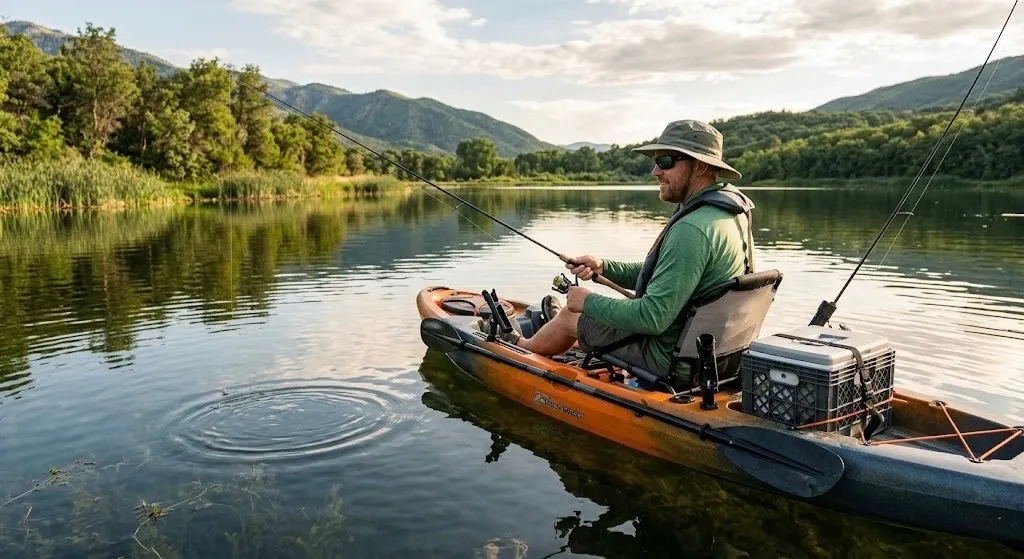
Written by Hudson Reed
Kayak fishing for beginners is one of the fastest ways to go from standing on a crowded bank to fishing water nobody else can reach, and you don't need to spend $3,000 to do it right. I've seen guys show up to the water with $1,500 pedal drives fully rigged with fish finders and catch nothing. I've also watched a guy in a $400 sit-on-top pull bass out of a shallow cove all morning while the rest of us couldn't get near it. The gear matters less than people think. How you use it matters a lot more.
This guide is going to walk you through everything you actually need to know: how to pick your first kayak, what gear to buy and what to skip, how to stay safe, and how to start catching fish from day one. No fluff, no affiliate padding, just what works.
Why Kayak Fishing for Beginners Is the Smartest Move in Freshwater
A kayak unlocks water that bank anglers and boat anglers can't touch. That's the real advantage: not the exercise, not the Instagram shots, not any of the lifestyle stuff. It's access.
Think about the shallow backwater cove behind a fallen tree. A boat can't get there without blowing out the area. Wading in spooks everything. But a quiet kayak slipping in from 40 yards away? You're invisible. Kayaks draw as little as 3-4 inches of water, which puts you in coves, creek arms, lily pad flats, and tidal marshes that stay completely unpressured even on a busy weekend. Those are often the most productive spots on any lake or river.
Beyond access, the economics are hard to argue with. A new bass boat runs $20,000 to $50,000 before you add a trailer, insurance, fuel, and launch fees. A solid starter fishing kayak with everything you need runs $500 to $800 all-in, and if you buy used, even less. That's a real fishing machine for the price of a decent rod-and-reel combo at a boat dealer.
What Kind of Kayak Should a Beginner Buy?
Buy a sit-on-top fishing kayak. Full stop. That's my recommendation for almost every beginner, and here's why: when you flip one (and at some point you will), you can climb back on without bailing water. Sit-inside kayaks fill up. Sit-on-tops don't. They're also easier to rig, easier to get in and out of at the water, and most models have built-in rod holders and gear tracks from the factory.
For length, aim for 10 to 12 feet. Shorter than 10 feet and the kayak is hard to track straight, and you'll be fighting it constantly. Longer than 12 feet adds weight and transport hassle without much payoff at beginner skill levels. Width matters too: a kayak 30 inches or wider gives you a stable platform for casting and landing fish without white-knuckling every movement.
On the paddle-versus-pedal question: start with a paddle kayak. Pedal-drive systems are genuinely useful but they add $500-$1,000 to the price, they can't go in shallow water without damaging the fins, and they have moving parts that break. Learn the basics on a paddle kayak first. You'll understand the water, the drift, and the casting rhythms better for it. Upgrade later if you want hands-free trolling capability.
Some solid beginner options in the sub-$600 range include the Lifetime Tamarack Angler 100 and the Pelican Sentinel 100X. Both are stable, have rod holders, gear storage, and will hold up for years of weekend fishing. Don't buy from an unknown brand just to save $50. You want decent warranty support and replacement parts available.
Can You Buy a Used Kayak and Not Get Burned?
Yes, and I'd strongly recommend it for your first kayak. Kayak fishing blew up during the pandemic, which means there's a glut of barely-used fishing kayaks on Craigslist, Facebook Marketplace, and local paddling forums right now. Serious anglers upgrade constantly, and their 2-year-old Pelican or Lifetime gets listed for 40-50% of retail in great condition.
When inspecting a used kayak, check for UV damage and cracks around the hull, especially near the seat tracks and any molded-in rod holders. Press on the plastic: it should feel firm, not brittle. Look for delamination, stress fractures near the bow and stern, and make sure all the scupper holes are clear and undamaged. Bring a hose if you can and check that drain plugs seal properly.
A used Hobie Mirage Drive kayak that originally sold for $2,500 can be found for $900-$1,200 in good condition. That's a legitimate upgrade buy if you've already decided kayak fishing is your thing. For a true first-timer though, grab something reliable in the $300-$500 used range and fish it hard for a season before you know what you actually want in a kayak.
You might also enjoy: Spring Crappie Fishing Tips: Ice-Out to Spawn
The Gear You Actually Need (And What You Can Skip)
Here's where most beginners overspend before they ever wet a line. Every kayak fishing YouTube channel is rigged with $400 fish finders, rod holders bolted everywhere, anchor trolleys, and custom paddle leashes. You don't need any of that on day one. Here's what you actually need:
Non-negotiable gear:
- PFD (life jacket): wear it, not just carry it. The U.S. Coast Guard reports that 85% of recreational boating drowning victims were not wearing a life jacket. Get a Type III fishing-style PFD with front pockets so you can store pliers and small tackle within reach. Budget $60-$100.
- Paddle: buy the best paddle your budget allows. A cheap, heavy paddle destroys your shoulders on a long day. Carbon or fiberglass blades with a fiberglass shaft run $80-$150 and are worth every dollar. Your paddle is your engine.
- Paddle leash: a simple coiled leash that clips your paddle to the kayak. $10-$15. Indispensable when you drop it while fighting a fish.
- Dry bag: for your phone, keys, and wallet. A 5-liter roll-top runs about $15. Do not skip this.
- Safety whistle: USCG-approved pealess whistle. Clip it to your PFD. Costs $5. Required by law in most states.
Nice-to-have on day one:
- Milk crate zip-tied to the rear tank well: holds tackle bags, adds cheap rod holders via foam inserts ($20 total)
- Anchor (a small 3-lb folding grapnel anchor with 30 feet of line, $25) for holding position in current or wind
- Landing net with a rubber mesh: easier than lipping bass off the side of a kayak
What you can skip for now:
- Fish finder: useful, but learn to read water first. Add one after your first full season.
- Pedal drive upgrade: wait until you know you want it
- Kayak cart: useful for long carries, but haul it by hand until you identify your regular launches
- Outriggers/stabilizers: if you feel like you need these, the kayak is probably too narrow or you're standing too early
Realistic total startup budget: $400-$500 for a used kayak, $60-$100 PFD, $80-$150 paddle, $50 for small accessories. You're fishing for under $700. Add a fishing license (around $25-$50 depending on your state), and you're on the water.
What Rod and Reel Setup Works Best on a Kayak?
Your shore fishing rods are probably too long. A 9-foot rod makes sense standing on a bank, but on a kayak, you're sitting about 6 inches above the waterline and casting in tighter quarters. The sweet spot for kayak fishing is 6'6" to 7'6". I lean toward 7-footers for most applications: long enough for decent cast distance, short enough to handle without constantly banging the paddle or the hull.
For freshwater bass and panfish, which is where most beginners start, a medium-power fast-action rod with a 2500-series spinning reel is the all-around workhorse. Spool it with 10- or 15-pound braid, add a 10-pound fluorocarbon leader, and you can throw 95% of the lures you'll ever need. Don't bring more than 2-3 rods until you're comfortable managing them on the water. Every extra rod is another thing to trip over, tangle, or lose over the side.
Keep it simple with your lure selection too. A paddle tail soft plastic on a 3/8-oz swimbait head, a Texas-rigged 4-inch worm, and a small topwater popper will put you on fish almost anywhere in the country. Add one more based on conditions and you're set.
How Do You Stay Safe on the Water as a Beginner?
Safety is where kayak fishing is genuinely different from bank fishing, and you need to take it seriously without letting it paralyze you. Three rules cover most situations:
Dress to swim, not to fish. Water temperature, not air temperature, is what kills people. Cold water shock can incapacitate a swimmer in under a minute at 50°F. In spring, when air temps feel warm but water is still cold, wear a wetsuit bottom or a water-resistant layer over your lower half. Cotton is actively dangerous when wet. Wear moisture-wicking synthetics or wool.
Rig to flip. Assume everything in your kayak will hit the water at some point. Attach your paddle with a leash. Put your phone in a dry bag. Clip tackle boxes to the seat. Loose items in a kayak are donations to the lake. Seriously, I've donated a pair of sunglasses, a tackle bag, and a rod holder bracket to various bodies of water over the years.
Tell someone where you're going. File a float plan, even a text to a friend saying "fishing at [location], back by 2pm," before every trip. If you're paddling somewhere remote, bring a fully charged phone in a waterproof case and know the emergency number for your county. According to Kayak Angler Magazine, VHF radios are worth carrying if you're on open water where cell coverage drops out.
You might also enjoy: How to Catch More Fish After a Bad Trip: Turn Slow Days Into Data
One more thing on safety: stay off water that's over your skill level. Open bays, reservoirs with heavy boat traffic, fast river current: all of those have a learning curve. Start on small lakes, ponds, and slow-moving creeks. Build your paddling skills before you chase stripers in a tidal estuary.
Where Should Beginners Fish From a Kayak?
Start close to civilization and work outward. A small reservoir, community lake, or slow river near your house is perfect for your first 5-10 trips. You're learning the kayak as much as you're fishing: how it tracks, how it drifts in wind, how to manage your gear while actively fighting a fish. All of that is easier to sort out somewhere familiar.
Once you're comfortable, start targeting the water types that reward kayak fishing specifically: narrow creek arms, shallow flats, overgrown coves, backwater sloughs. On rivers, look for eddies behind large boulders and logjams, places where current stalls and baitfish stack up. On lakes, paddle quietly along weed edges and points early in the morning when fish are shallow.
The biggest kayak fishing advantage is stealth. You're low to the water and nearly silent. Use that. Cut your engine (your paddle) well before you reach a productive-looking spot and drift or use small corrective strokes to position. Fish that blow out from an approaching kayak are fish that will stop biting, and fish that don't know you're there are fish you can catch.
Do You Need a License to Kayak Fish?
Yes, in almost every state. Fishing from a kayak is still fishing: the kayak doesn't change your licensing obligation. Most states require an annual freshwater fishing license ranging from about $20-$50 for residents. Some states, like Colorado and Wisconsin, also require kayaks to be registered as a watercraft if they're over a certain length, which typically costs another $20-$40 per year.
Check your state fish and wildlife agency website before your first trip. It's not glamorous advice, but a $250 fine for fishing without a license on your first kayak outing is a rough way to start the hobby. Licenses can be purchased online in about 3 minutes in most states, and there's no reason to skip it.
One nuance: some state parks and private impoundments require a separate access permit or day-use fee on top of your fishing license. Call ahead or check the DNR website for any water you're fishing for the first time.
How Fast Can You Get Good at Kayak Fishing?
Faster than you think, honestly. The fishing skills you already have, reading water, presentation, knot tying, transfer directly. What takes practice is the kayak-specific stuff: managing drift, casting from a seated position, handling fish without standing up, and keeping your gear organized under your feet instead of spread out on a bank.
Most people feel genuinely comfortable on a fishing kayak after 3-5 outings. After 10 trips, you'll be fishing specific spots with real confidence and thinking about upgrades. The biggest accelerant is simply going. Don't wait for the perfect conditions or the perfect gear list. Throw your rod and your PFD in the car and get on the water. That's how you learn.
One practical tip: your first couple of paddles, skip the fishing entirely. Just paddle. Learn the forward stroke, practice turning, try a wet exit in shallow water you can stand up in. You'll fish better for it. A confident paddler is a confident angler on a kayak: the two aren't separate.
If you want to keep track of where you're finding fish, what's working, and how your outings are building over time, Bushwhack makes that easy: log your spots, conditions, and catches so you can actually learn from your time on the water instead of just collecting vague memories. That pattern recognition is what separates anglers who catch fish consistently from those who just show up and hope.
Get fishing tips in your inbox
New guides, seasonal tactics, and gear picks — about once a month, no spam.