How to Fly Cast in the Wind: 5 Adjustments That Actually Work (Without a Single Haul Lesson)
 Cameron Spanos
Written by Cameron Spanos
Most articles about how to fly cast in the wind open with the same sentence: learn the double haul. Helpful if you are home on the couch. Useless if you are knee-deep in the Madison at 2 p.m. with a 18 mph crosswind already pushing your loop into the willows behind you.
This is the other guide. Five adjustments you can make on the water, right now, with the cast you already have. None of them require a haul. Some of them will feel wrong the first time you try them. They still work.
Why most advice on how to fly cast in the wind fails intermediate anglers
The classic answer to wind is more line speed, and the classic way to make more line speed is the double haul. Fine. But the double haul is a real skill. The Federation of Fly Fishers Casting Instructor program treats it as a separate certification topic for a reason. You do not casually pick it up between rising fish.
Meanwhile, the actual problem in front of you is geometric, not athletic. The wind is pushing your line where you do not want it. The fixes that move the needle most are the ones that change where your line travels, not how fast it travels. That is good news, because angles are easier to change than mechanics.
One more thing before we get into it. According to Hatch Magazine, a steady 10 mph wind starts to bother most fly anglers, and 25 mph is where the day becomes "an exercise in masochism." Most safe-wading guides put the practical upper limit somewhere between 15 and 20 mph depending on water size. The adjustments below are for that messy band from roughly 10 to 20 mph where the fish are still eating but your cast is falling apart. Above 20, the smart move is usually to drive to a sheltered piece of water or go home and tie flies.
1. Drop your casting plane: sidearm from a crouch
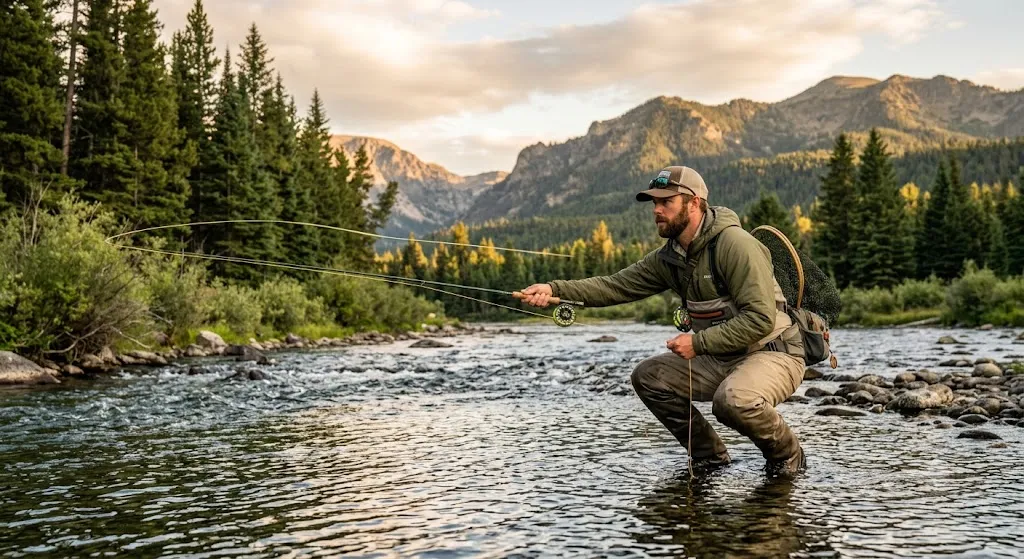
This is the single highest-leverage adjustment, and the one most anglers resist because it looks ugly.
Wind speed scales with height above the water. The boundary layer right against the river surface is dramatically slower than the air five or six feet up where your standard 10 o'clock-to-2 o'clock cast is happening. A USDA Forest Service primer on micrometeorology pegs near-surface wind at roughly 60 to 70 percent of the speed measured at standard 10-meter reporting height. That difference is the gap between a cast that turns over and a cast that piles.
So: drop the cast under the wind.
How to actually do it
- Bend at the hips and knees until your rod hand is roughly belt-high or lower. A half crouch is usually enough on small water.
- Rotate your casting arm so the rod travels horizontally, parallel to the water, on both the back cast and forward cast. Not diagonal. Flat.
- Keep your stroke length the same as normal. Resist the urge to power through. A crisp stop matters more than muscle.
- Aim the forward cast just above the water, not at it. You want the line laying down low, not slapping.
Two warnings. First, sidearm casts cost you distance, which is fine because you are also going to shorten up (see #3). Second, your back cast is now traveling at face height for anyone behind you. If you are fishing with a partner, make sure they are out of the arc before you start.
2. Reposition so the wind is off your casting shoulder
This sounds obvious. Almost nobody actually does it.
If you are right-handed and the wind is blowing from your right, every forward cast is delivering the fly straight at your ear. That is dangerous on small flies and genuinely scary with a weighted streamer or a beadhead Pat's Rubber Legs. The fix is not technique. The fix is geography.
Walk. Wade across to the other bank if you can. Fish the opposite seam. Approach the same run from downstream instead of upstream. The goal is to put the wind on your off shoulder so any line drift moves the fly safely away from your body.
You might also enjoy: Middle Provo River Wade Fishing: Access, Parking, and Hatches Mile by Mile
On a small freestone this might be a 30-second wade. On bigger water it might mean driving to a different access point. Both are faster than spending the next two hours getting hit in the back of the head by a tungsten cone.
Two situations where you cannot reposition:
- The bank is undercut or impassable. Now you flip to a backhand cast (rod tip on your off side, casting across your body) or do the over-the-top rod-tilt trick where you cant the rod over your head so the line travels on the downwind side.
- The fish is in a specific lane you can only reach from one bank. In trout fishing, this is rarer than you think. Most fish have multiple drift lanes you can present to. Pick the one with friendly wind.
3. Cut your leader and go heavier on tippet
Leader turnover dies in the wind before anything else does. A 9-foot 5X tapered leader with two feet of 6X tippet is asking that thin terminal end to defeat 15 mph of moving air using nothing but momentum it inherited from a much fatter section ten feet upstream. It loses.
The standard windy-day fix from Midcurrent and most guide-school curricula:
- Cut total leader length by 18 to 24 inches. A 9-foot becomes a 7.5-foot. Optionally cut to 7 feet if it is really howling.
- Step up one or two tippet sizes. 5X becomes 4X or 3X. The added stiffness in the terminal section forces turnover instead of letting the wind crumple it.
- Trim the butt section, not the tippet, when you cut. The thick butt is what cuts the wind on the front of the leader. Keeping butt mass while shortening overall length is the sweet spot.
Will trout refuse a 3X tippet they would have eaten on 5X? On a hard-fished spring creek in clear water, occasionally yes. On 90 percent of trout water, no. The trade is worth it. A drag-free drift on heavier tippet beats a perfect-spec setup that lands in a pile six feet short.
One nuance: if you fish euro nymphing-style sighter leaders, the rules invert a bit. Those are already designed to cast tight loops with weighted flies, and a Bushwhack log of your last few outings probably tells you they handle wind better than indicator rigs already. Stick with what you have and skip this step.
4. Switch to nymphs (or anything weighted)
A size 14 Parachute Adams weighs essentially nothing. The wind owns it. A size 14 beadhead Pheasant Tail weighs enough that you can sling it through a stiff breeze with mediocre form and still get a passable drift.
This is not a complicated insight, but it changes the whole strategy of the day:
- No false casting required. Pick up, swing, lob. The weight loads the rod.
- The fly hits the water with intent, not a feather-drop. Wind disturbance on the surface is already masking your splash, so a slightly clunky entry costs you nothing.
- You can fish closer. Most nymphing happens inside 25 feet, where wind has the least time to push your line off course.
If you are committed to fishing on the surface, this is where you take the L and accept that some days are not dry fly days. Hatch matching takes a back seat to fishing what you can actually present.
What about streamers?
Streamers in wind are a trap that catches a lot of intermediate anglers. They feel like the right call because they are weighted, but weighted articulated streamers are also large and high-profile in the air. With a side wind they become a hazard. Stick to smaller weighted nymphs or sparse soft hackles unless the wind is at your back.
5. Wait for the lull
The cheapest adjustment in fly fishing.
Wind in most river valleys is not a constant. It comes in cycles tied to thermal heating, cloud cover, and topography. Watch a stand of cottonwoods on the bank for 20 minutes and you will see the leaves go still for 30 to 90 seconds at a stretch, often every few minutes. Those are your windows.
You might also enjoy: Fly Fishing Utah for Beginners: 5 Forgiving Rivers
The intermediate angler's mistake is to keep casting through everything. The good angler casts during lulls and uses gusts to do something else. Specifically:
- During gusts: Mend, reposition, fix your tippet, change flies, watch the water for rises.
- During lulls: Cast immediately, even if the drift is not perfect. You have 45 seconds, maybe less.
This sounds like it will cut your fishing time in half. It does not. Most anglers spend more than half their on-water time not actually presenting a fly anyway. You are just being deliberate about when that down time happens.
How do I know if it is too windy to fish at all?
Three quick tests. Any one of them is a sign to relocate, not push through.
First, the casting test. If your forward cast cannot turn over a roll cast at 25 feet with the heaviest rig you brought, you are not going to fish this water effectively today. Drive.
Second, the wading test. If a gust is moving you sideways in calf-deep water, the wind has already exceeded your safe stance. Wading guides from American Whitewater and most state agencies say to back out before you lose footing, not after.
Third, the audible test. If you can hear individual wind gusts as a low roar across open water (as opposed to a wash of leaves on shore), you are well past 20 mph and into the range where casting becomes guesswork.
What about a tailwind? Don't I just cast farther?
Tailwinds are oversold. Yes, your forward cast goes further. But your back cast is now fighting headwind, and a collapsed back cast means no load on the forward cast, which means your shiny tailwind delivery turns into a 12-foot heap.
The fix: angle your back cast higher than normal, almost up into the wind, and your forward cast lower than normal. You are using the wind, not fighting it on either end. This is the one wind direction where most intermediate anglers underperform compared to what is actually available, because they assume the wind is doing all the work for them.
The shape of a good windy-day session
One pattern shows up across every guide writeup I have read and every windy day I have personally fished. Windy days reward anglers who narrow their game. Fewer fly changes. Fewer long casts. More time reading water, less time presenting. Tighter, closer, lower.
If you fish a Bushwhack-style log of your sessions you will probably see the pattern in your own data. The days you came home with fish on wind-heavy forecasts were not the days you cast best. They were the days you fished smallest.
Wind is not a casting problem. It is a decision problem. The five adjustments above are just the cheapest way to bias every decision in your favor for the next four hours of fishing.
Get fishing tips in your inbox
New guides, seasonal tactics, and gear picks — about once a month, no spam.