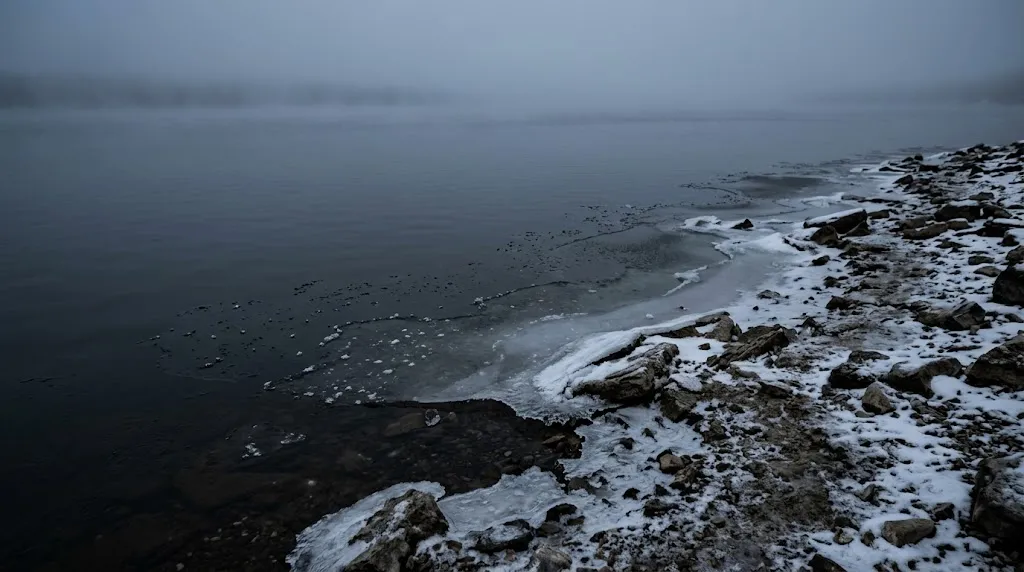
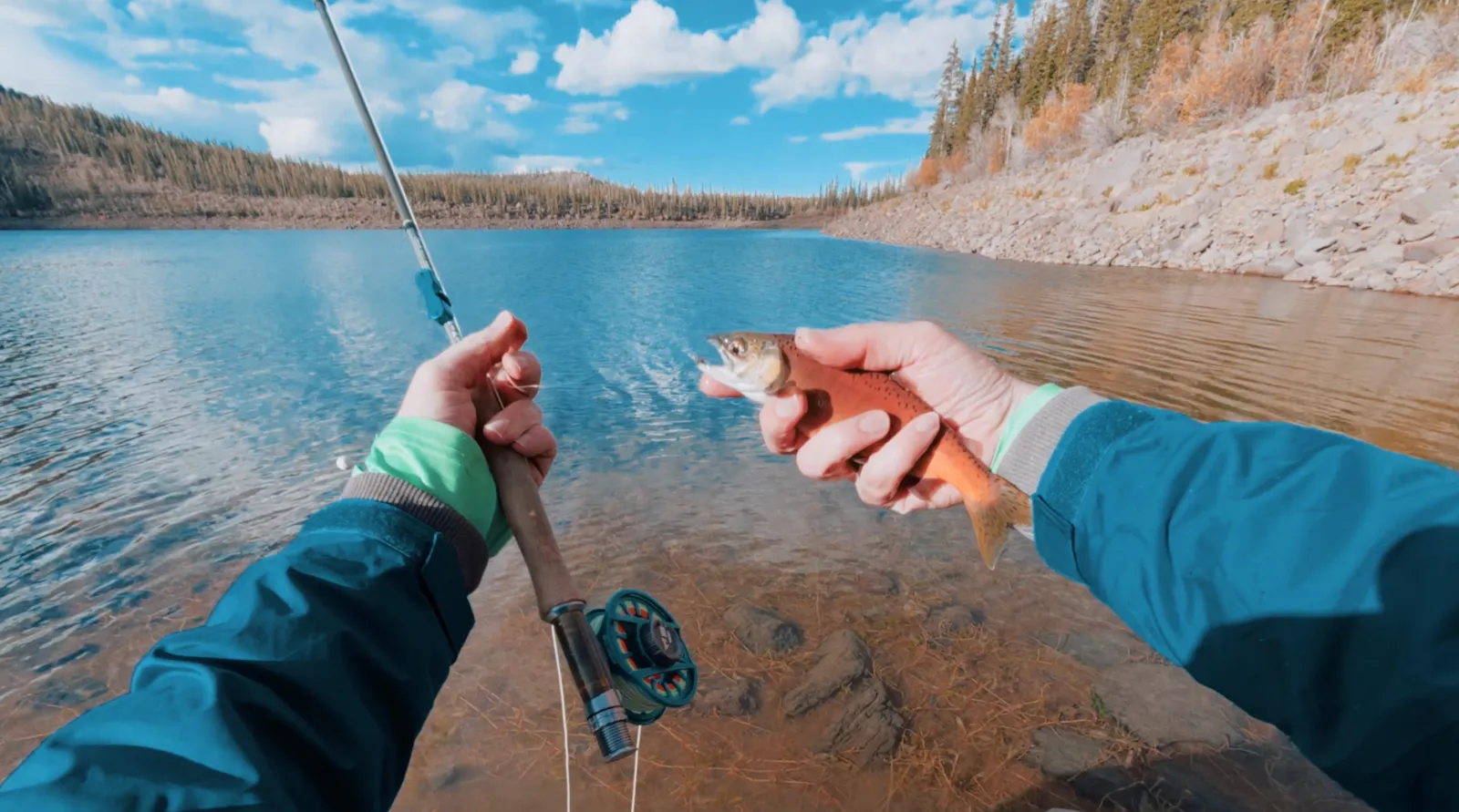
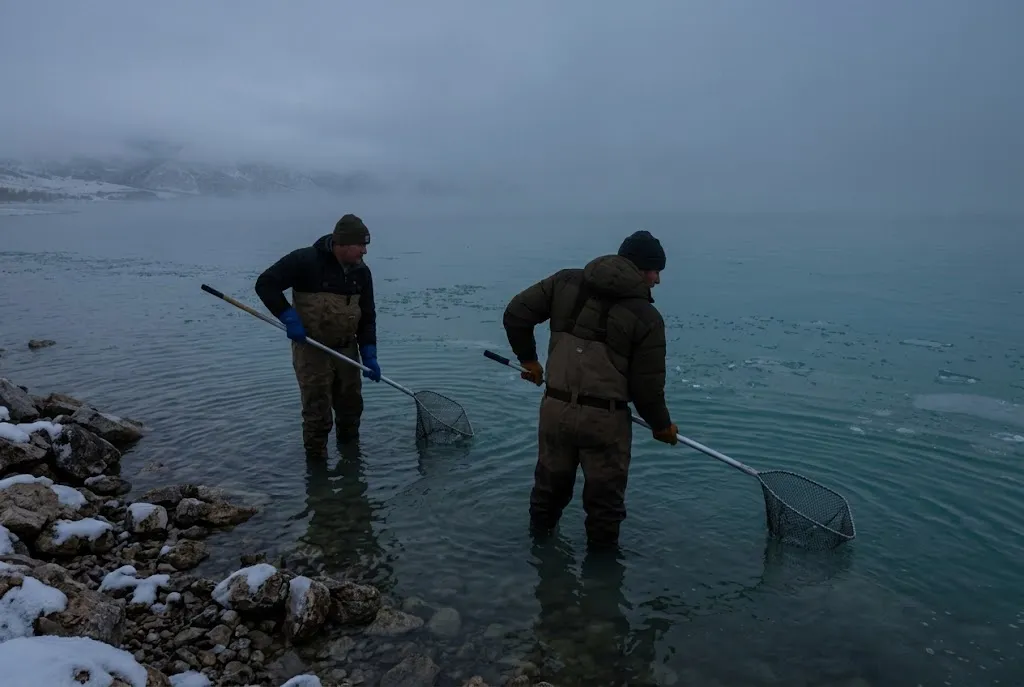
Flaming Gorge Burbot Ice Fishing: Glow Jigs After Dark on the Rocky Points (and Why There's No Limit)
 Hudson Reed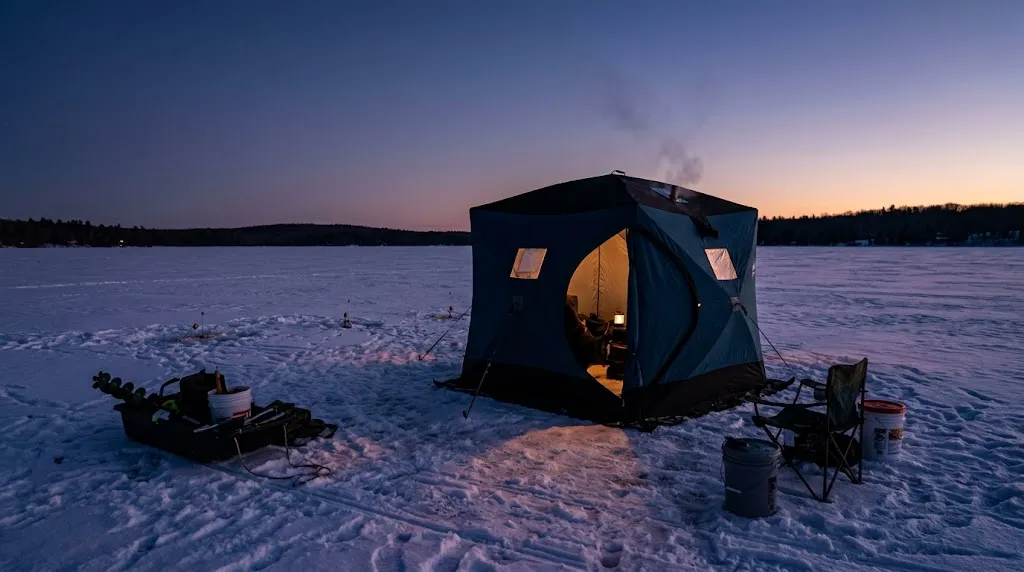
Written by Hudson Reed
If you show up to the ice at dark with an auger in your hand, you've already blown the best hour of the night. Flaming Gorge burbot ice fishing is won in the afternoon: holes drilled, rods rigged, glow jigs charged, everybody sitting quiet on a rocky point by the time the sun drops behind the hills. Burbot start feeding around sunset, and the angler still running a gas auger at 6 p.m. is the reason the guy 200 yards away is catching them and he isn't.
And it's a fishery that wants you to keep everything. No limit, no releasing, and both states would rather you filled the cooler.
Flaming Gorge burbot ice fishing starts before the sun goes down
Burbot are night fish. Wyoming Game and Fish's how-to guide for catching burbot puts it plainly: they hide under rocks and in cracks during the day, emerge to feed around sunset, and the first few hours after sunset and the stretch before sunrise can both be very productive. Some anglers report a mid-night bite too, but that first push at dusk is the one you plan the trip around.
The same guide says experienced anglers drill 20 to 30 holes or more before a line ever goes down. Noise moves fish. Drill once, then shut up.
So get there in the late afternoon. Drill a spread that runs from shallow to deep across the point, maybe 10 feet out to 50, and use the daylight to fish for lake trout pups. Lakers 28 inches and under have no limit on either side of the reservoir (Utah's 2026 guidebook and Wyoming's Chapter 46 both say so; only one fish over 28 inches), so the afternoon isn't wasted, and a dead pup you've kept is legal burbot bait on the Utah side (more on that below).
Then, when the light goes flat and orange, stop drilling. For good.
Where burbot hold: the rocky point, not the cliff face
Rock is everything. Burbot at the Gorge relate to rocky bottom on the main reservoir and in the bigger bays, and WGFD's guidance gets specific in a way most write-ups skip: the deep water directly in front of a sheer cliff usually holds few fish. The productive water is next to it, where the slope eases off to something under about 60 degrees, plus the mouths of bays inside cliff complexes that have gradual, rocky shoals.
That's my biggest piece of advice for a first trip, and it's the one people ignore. Everybody wants to set up under the most dramatic wall on the lake because it looks fishy. Walk 100 yards down the shoreline to where the rock starts sloping into a bench, and drill there instead. Burbot come up out of the deep water at dusk to forage on those shelves, and a lure sitting over a sheer drop-off is mostly fishing for nothing.
A topo map or a mapping app like Navionics helps you find those benches before you go.
The glow jig rig, step by step
Nothing about this setup is fancy. WGFD recommends grub- or tube-bodied jigs or jigging spoons from 1/4 to 1/2 ounce on 2/0 to 4/0 hooks, with 8- to 12-pound test, because "burbot have hard mouths and get big." How big? WGFD's "Bye-Bye Burbot" feature (linked below) reports fish over 40 inches from the Green River drainage.
Once the spread is drilled, set up each hole like this:
- Charge the jig or spoon with a UV flashlight until it's glowing hard, because a lure that's faded to a dim smudge isn't going to pull a fish from 10 feet away in black water.
- Tip the hook with a skin-on strip of sucker or chub meat no bigger than about 1 inch by 1/2 inch, which is plenty of scent without turning the jig into a fish-shaped brick.
- Drop it to the bottom, then reel up until it's hovering within a few inches of the rocks, since burbot feed with their chins practically dragging and a jig a foot up gets ignored.
- Spread your lines across different depths at first, then pull the dead rods into whatever depth band is producing as the night goes on.
- Give each hole about 15 minutes, and if it hasn't produced a bite, move the line rather than waiting it out.
- Recharge the glow every single time you check a line, because WGFD says those lures dim in as little as 15 to 20 minutes and it's common to get bit right after a fresh charge.
Step six is where most nights are won or lost. A cheap UV light does a better job than a headlamp, and I'd buy one before I'd buy another rod.
You might also enjoy: Ice Fishing Gifts Under $100: 8 Picks Sorted by What He Already Owns (2026)
You can run up to six lines here, and tip-ups catch fish, but keep one rod in your hand and jig it lightly. WGFD notes burbot can swallow a lure without tripping the flag, so when you check a tip-up every 20 minutes or so, hand-jig it a few times before you assume it's dead. And when you do catch one, get back down fast. They travel in small schools, and the second fish is usually right there.
Sucker meat, and what's actually legal as bait
Sucker or chub meat is the standard, and it's legal on both sides, but the rules aren't identical. Utah's 2026 guidebook allows dead white sucker, Utah sucker, mountain sucker, Utah chub and carp as bait anywhere bait is allowed, and it specifically allows dead burbot and lake trout from Flaming Gorge as bait at Flaming Gorge only. On the Wyoming side, live baitfish are prohibited in Area 4, but burbot are classified as nongame there, and Wyoming's Chapter 46 rules let you use any part of a nongame fish as bait. Translation: your first burbot of the night is bait for the second one, on either side of the line.
What's the burbot limit at Flaming Gorge?
There isn't one. Both Utah and Wyoming set no limit on burbot at Flaming Gorge, and both require you to kill every burbot you catch immediately. Releasing one alive is illegal in both states. Utah's 2026 Utah Fishing Guidebook spells it out ("Anglers must not release any burbot they catch. All burbot must be immediately killed."), and Wyoming's Chapter 46 fishing regulations, effective January 1, 2026, designate burbot as nongame in Area 4 and require every one caught to be killed immediately.
The reason is simple. Burbot don't belong here. They were illegally introduced into the Green River drainage, and WGFD first documented them in Flaming Gorge in 2006. According to Wyoming Game and Fish's "Bye-Bye Burbot" feature, crayfish were wiped out of the reservoir by 2010, and within a few years of burbot showing up, most smallmouth under 12 inches on the Wyoming side were gone. Biologists have pulled 15- to 16-inch kokanee out of burbot stomachs.
"Their aggressive feeding behavior is their Achilles heel."
Robb Keith, former Green River Region fisheries supervisor, Wyoming Game and Fish Department
Utah vs Wyoming: the rules that actually differ
The headline rules match. The details don't.
| Rule (2026) | Utah side | Wyoming side |
|---|---|---|
| Burbot limit | No limit | No limit (nongame in Area 4) |
| Release allowed? | No, kill immediately | No, kill immediately |
| Lines through the ice | Up to 6 | Up to 6 |
| Name on each line | Required if using more than 2 | Required if using more than 2 |
| How far from your lines | Within sight, no more than 100 feet | No more than 300 yards |
| Ice hole size | No restriction at Flaming Gorge | No Flaming Gorge restriction in Chapter 46 |
| Fish as bait | Dead burbot and lake trout from the Gorge, plus listed suckers, Utah chub, carp | Any part of a nongame fish (burbot included); no live baitfish |
| Chumming | Allowed with legal baits, dead burbot or lake trout | Not addressed for the Gorge in Chapter 46; ask WGFD |
That 100-foot rule on the Utah side is the one to watch. Six lines spread across a big point can easily put your far tip-up out of bounds while you're standing at the near one. On the Wyoming side you've got 300 yards of slack.
Licensing trips people up too. Utah's guidebook says a Utah or Wyoming resident fishing the other state's water needs their own resident license plus the other state's reciprocal permit, and a nonresident of both needs a nonresident license from each state to fish the whole reservoir. And holding licenses in both states doesn't double anything: Utah allows only one daily limit at Flaming Gorge, so a reciprocal permit buys you water, not a second limit of trout or kokanee. One night-specific trap: Utah closes Linwood Bay, west of the line to Lucerne Point, to nighttime angling from October 15 through 6 a.m. on the second Saturday of December. In a rare early-ice year, that matters.
And if you're also chasing browns on the Green River below Flaming Gorge, Utah's must-kill rule for burbot follows you downstream. Any burbot caught from the dam down to the Colorado confluence has to be killed too.
Lucerne or Buckboard? Picking a side of the lake
Flaming Gorge is 91 miles of reservoir split by a state line, and the ice doesn't come on evenly. The upper, Wyoming end freezes first and thickest. The Utah canyon end freezes later and thinner, and the stretch near the dam sometimes doesn't lock up at all. A Utah DWR report from March 27, 2023, late in a heavy ice year, gives you the shape of it: about 12 inches at Sheep Creek, 14 inches at Linwood Bay, Lucerne and Antelope Flat, 16 to 18 inches at Brinegar, and 20 to 25 inches at Buckboard, getting thicker the farther uplake you went.
Buckboard is the safer bet early in the season. It's on the Wyoming side off WY-530 on the west shore, and the ice there usually firms up before the Utah end. The rocky points and the old channels uplake toward the Blacks Fork and Green River arms are classic burbot water. You'll need Wyoming licensing (or a reciprocal permit) to fish it.
You might also enjoy: Best Ice Fishing Bibs Under $300 (2026): The Float Two-Piece, and Why This List Is Short
Lucerne Valley, east of Manila on the Utah side, puts you near Lucerne Point, Linwood Bay and a lot of rocky shoreline that suits burbot well. The tradeoff is ice that tends to come later and run thinner.
Firehole on the Wyoming east side and Antelope Flat near Dutch John on the Utah side also see ice traffic. Most developed facilities close for winter.
My take: go Buckboard for your first trip of the season, and save Lucerne for after you've got a recent, credible thickness report from someone who drilled there that week.
When does burbot season on the ice actually start?
Usually first ice in late December, running into February, with the uplake Wyoming end opening up first. The fish are around before that (open-water anglers target prespawn burbot in the Green River and Blacks Fork arms from mid-October into November), but the ice window is what most people mean by burbot season.
It's also a spawning window. The same "Bye-Bye Burbot" feature notes burbot eggs deposited on near-shore spawning habitat in late December, so fish move shallow. You don't need to chase them deep.
Don't trust the calendar, though. The 2026 Burbot Bash was cancelled over poor ice and forecast wind, and WGFD says the 2027 tournament is tentatively set for January 22 to 24. Warm winters happen here. First ice in Utah runs on elevation, and the Gorge sits around 6,000 feet, so it usually trails the high Uinta lakes. Check the current UDWR and WGFD fishing reports before you load the sled.
A night ice-safety checklist for the Gorge
Night changes the math on ice. You can't read color or see a pressure ridge from 50 yards out, and overnight lows on the Gorge can drop below 0°F, according to WGFD. Past ice reports on the reservoir have warned about springs, gas vents and pressure ridges. This is the list I'd actually pack against:
- A fishing partner. Not optional at night.
- Ice picks worn around your neck, a throw rope, and a flotation suit or PFD.
- A spud bar to test ice as you walk out, especially near points where current and springs thin things out.
- A headlamp plus a backup light.
- Your walk-out route saved on a GPS or phone app, because every point looks the same at 10 p.m.
- Someone at home who knows where you parked and when you'll be back.
Wait for at least 4 inches of clear, solid ice before walking out, and more than that before you bring a machine. Gray, snow-covered or slushy ice doesn't count toward that number.
Bring towels and a big cooler or heavy trash bag for the haul. Burbot are slimy and coil around your wrist like an eel. They're worth it: the white, flaky meat fries up beautifully.
If you do get into them, write down the point, the depth band and the hour the bite started. Burbot nights repeat. A few seasons of notes in a fishing log like Bushwhack will tell you which shoal fires at dusk and which one only turns on at 2 a.m., and that's worth more than any lure in your box.
Get fishing tips in your inbox
New guides, seasonal tactics, and gear picks — about once a month, no spam.