Blue-Lining for Wild Brook Trout: The Cool-Water Refuge Play for Summer Heat
 Cameron Spanos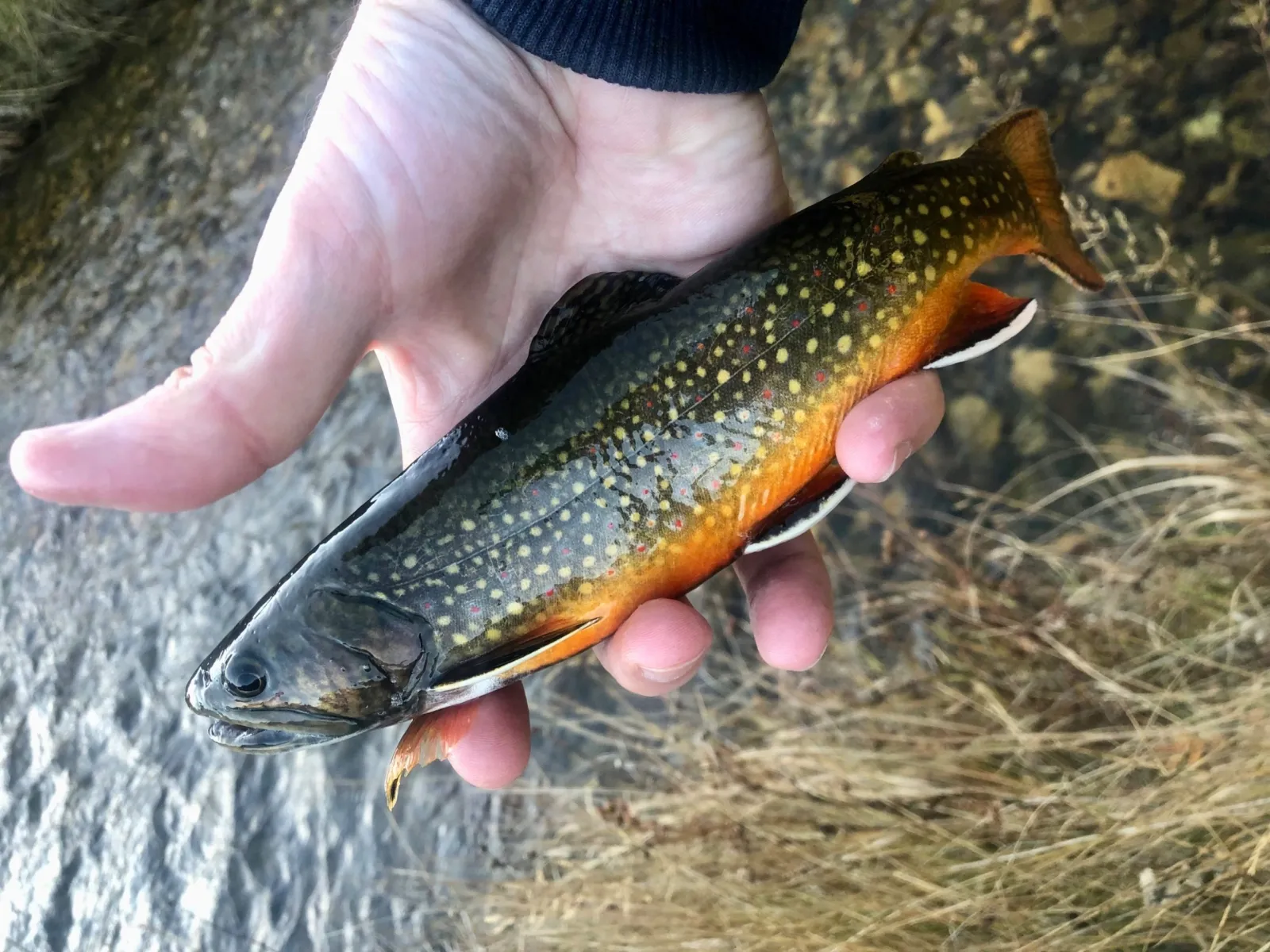
Written by Cameron Spanos
The main river reads 71 degrees on the stream thermometer by nine in the morning, and every trout in it has gone sullen. That's your signal to stop staring at the water in front of you and start reading the mountain above it. Blue-lining for wild brook trout is the play when July heat shuts down the big water, because the tiny high-gradient headwaters that feed those rivers stay cold when everything downstream cooks. Skinny little threads of water tucked under rhododendron, dropping over rock in a stair-step of plunge pools, full of fish that have never seen a fly. If you've fished trout for years but never gone up after natives, this is the summer to start.
Blue-lining means chasing wild brook trout up the tiny headwater streams that show as thin blue lines on a topo map. It works in summer because those high, shaded, steep little creeks stay cold and oxygen-rich when valley rivers overheat, giving native brookies a refuge and giving you fishable water when everything downstream shuts down.
Brookies aren't really trout, for one thing. They're char, cousins to bull trout and Arctic char, and they carry the same appetite for cold water. Non-native rainbows and browns pushed them out of most valley water generations ago, so the wild ones that remain got squeezed uphill into the coldest, steepest refuges left. Which is exactly where you want to be when the thermometer climbs.
Why headwater blue lines stay cold in July
Cold water is the whole game here. Brook trout have a comfort range of roughly 44 to 68 degrees with an optimal around 58, and they're the most heat-sensitive of the common trout you'll fish for. Field studies cited by Penn's Woods West Trout Unlimited note that brookies strongly avoid water above about 66 to 68 degrees, drifting upstream or stacking into cold seeps to find relief.
Penn's Woods West Trout Unlimited, citing regional field research, points out that brook trout feel the stress of warming water well before oxygen levels drop low enough to kill them, which is why they abandon marginal water for cold headwater refuges long before a stream becomes lethal.
Penn's Woods West Trout Unlimited
High-elevation headwaters give them that relief for a few reasons. They sit close to the source, often springs or seeps that run cold year-round. The canopy of rhododendron and mountain laurel that makes them so miserable to fish also shades the water all day. And the steep gradient keeps everything churning, tumbling, aerating. Colder water holds more dissolved oxygen, and a plunge pool that's constantly getting hammered by a little waterfall stays oxygenated even when air temps are brutal. That combination, cold plus shade plus oxygen, is why a blue line at 3,500 feet can be fishing beautifully on an afternoon when the tailwater below is a lost cause.
Elevation matters more than mileage. In the southern Appalachians, viable speck water usually sits at 3,000 feet or higher. Go up.
How do you find a blue line worth fishing?
Pull up a topo map, on paper or in an app, and look for the thin blue wrinkles feeding your known trout rivers. Those are the streams. The name comes straight from the map. Here's the part most people skip: not every blue line is equal, and the map tells you which ones to bother with if you know how to read it.
Start with a river that already holds trout and trace it upstream. Follow the tributaries, then the tributaries of those tributaries. The West Fork of the North Fork of some creek nobody's heard of is exactly the kind of thing that never gets fished. Look for a blue line that's fed by other blue lines, because more feeder water means more year-round flow and a better shot at fish surviving the dry months.
Watch the line style. A solid blue line means a perennial stream that flows year-round, while a dashed or dotted line marks intermittent flow that can dry up in late summer. For a July trip, favor the solid lines. Then check the contour lines crossing the stream: tightly packed contours mean steep gradient and lots of plunge pools, which is good, but contours stacked almost on top of each other can mean the stream is basically a waterfall with no holding water. You want a mix, steep enough to make pools, not so steep it's all cascade.
One more filter that saves a wasted hike. Drop your marked blue line into Google Earth and look at it from above. You can often see whether there's real water in the channel, spot where the canopy opens up, and gauge how brutal the approach is going to be. In the Appalachians, a barrier waterfall on the map is a good sign, because it blocks rainbows and browns from moving up and keeps the water above it all brook trout.
The right rod for tight, brushy water
Leave the 9-foot 5-weight in the truck. It'll snag on everything and you'll hate your life. Short is the rule up here. A 6-foot to 7-foot rod in a 2 or 3 weight is the sweet spot: short enough to sneak under a rhododendron tunnel, soft enough to protect a light tippet, and honestly overkill for fish that mostly run 6 to 10 inches. A fiberglass 2-weight is a joy on this water because an 8-inch brookie loads the whole rod and feels like a real fish.
You might also enjoy: How to Release Fish in Summer Heat So They Survive
Keep the rest simple. A short leader, 7 to 7.5 feet, because you're rarely making a long presentation and a long leader is just more line to tangle in the laurel. Floatant, a few flies, forceps, a thermometer, and water. That's the kit. You're going to be crawling and wading in a tight space, so the less you carry, the better.
Two casts that actually work under a canopy: bow-and-arrow and dapping
Forget the backcast. There's no room for one, and the sooner you accept that the sooner you'll catch fish. Two techniques do almost all the work on brushy blue lines.
The bow-and-arrow cast
This is the one to learn first. You pull out only as much line as you can hold under tension, usually 6 to 12 feet, pinch the fly by the bend of the hook, load the rod tip by drawing the fly back toward you, aim, and release. The bent rod slings the fly forward like an arrow off a bowstring. Orvis and small-stream guides teach this as the go-to for tight quarters, and Joe Humphreys built a whole reputation partly on how deadly it is in close.
A few things that make it click. Aim slightly high so the fly drops rather than smacks. Keep your rod hand steady and let go clean, don't flick your wrist. And accept that your first few will go sideways into a bush. Everybody's do.
Dapping
When you can get close, dapping is even simpler and sometimes more effective. You feed out just two or three feet of leader past the rod tip and lower the fly straight down onto the surface, no line on the water at all. On a tiny plunge pool where you can sneak the rod tip over the lip, you just drop the fly in the foam and hold on. It's about as close to cane-pole fishing as fly fishing gets, and native brookies eat it without hesitation because there's nothing unnatural for them to notice.
Stealth on skinny water
These fish are absurdly spooky, and on water you could step across, one clumsy move puts the whole pool down. The single biggest mistake anglers make on blue lines is getting spotted before they ever cast.
Fish upstream. Trout hold facing into the current, so coming from below keeps you behind their field of view. Stay low, kneel, crouch, sometimes crawl to the lip of a pool. Watch your shadow above all else, because a shadow crossing the water sends brookies bolting for cover faster than any noise. Wear drab colors, muted greens and grays, nothing bright. And approach each pool like it's the only one you'll get, because if you spook the fish at the tail, they blow up through the pool and warn everything ahead of you.
Brook trout often sit at the back end of a pool where the current fans out, so that's your first target, not the head. Fish the tail-out, then work your fly up toward the plunge. One good drift through the foam line usually gets an answer. If it doesn't, move on. Blue-lining is a covering-water game, not a grinding-one-spot game.
The flies: keep the box small
You don't need a hatch chart up here. Native brookies in headwater streams eat opportunistically because food is scarce and the season is short, so a high-floating attractor dry that they can see in broken water is almost always the answer. Leave the nymph box in the truck.
Four patterns cover it. A Stimulator in yellow or orange, sizes 12 to 16, doubles as a stonefly, caddis, and hopper and floats like a cork in the rough stuff. A Royal Wulff, whose white wings you can actually track in the foam and whose peacock body brookies seem to adore. A Humpy, which packs enough deer hair and hackle to ride high through the fastest plunge. And a plain old Adams when they want something a touch more subtle. Southern Appalachian guides lean hard on this exact family of attractors, and a deer-hair Irresistible is a fine fifth choice for the roughest water.
You might also enjoy: Trico Spinner Falls in July: The 7 AM Window Every Tailwater Angler Should Plan Around
Fish them dry, greased and floating high. Presentation matters far less than getting a natural drift through the seam without lining the fish. Precision beats fly choice every time on this water.
When is the water too warm to fish?
This is the part that separates a responsible angler from someone slowly killing the fish they claim to love. Blue-lining is a summer play precisely because the water stays cold, but you have to verify that, not assume it. Carry a thermometer and use it.
The working rule: once water hits the mid-60s and climbs, brookies get stressed, and by the upper 60s you should think hard about backing off. A fought fish burns oxygen it can't spare in warm water, and a trout that swims away looking fine can still die hours later from the stress, what biologists call delayed mortality. If a headwater reads 68 or above, you're not on cold-refuge water anymore, so hike higher or fish somewhere else. Because brook trout need more oxygen than rainbows or browns, they're the first to suffer as temps rise. There's a full water-temperature decision tree worth learning for trout in general, but the short version for blue lines is simple: cold water is the entire reason you're up there, so if it's not cold, leave.
Fish early. Morning water is at its coldest after a night of cooling, and the fishing is often best before the sun tops the ridge anyway.
Handling wild brookies so they live
These are native fish in fragile populations, and every one you release keeps the stream what it is. Handle them like it matters, because it does.
Pinch your barbs down before you start. Keep the fish in the water, get the hook out with forceps, and if you want a photo, keep it wet and quick, hands soaked, fish over the water so a wiggle drops it home instead of onto a rock. Skip the grip-and-grin held out at arm's length. A brookie in your palm for ten seconds over the surface is a better photo and a live fish. Never fight a fish to total exhaustion in warm water, and if the temp is marginal, honestly, just don't fish. The stream will be there in October.
Check your state regulations too, since many wild brook trout waters have special rules, single-hook or catch-and-release-only sections, and some are closed seasonally to protect spawning. Confirm the current rules with your state fish and wildlife agency for the 2026 season before you go.
Your first blue-line trip
Pick a solid blue line above 3,000 feet feeding a river you already know holds trout, ideally above a barrier falls. Go early on a hot morning. Rig a short glass rod, a 7-foot leader, and a size 14 Stimulator. Check the temperature the second you reach the water, and if it's below the mid-60s, start low and fish upstream, one drift per pool, staying out of sight.
The fish won't be big. A 10-incher is a trophy and most will be smaller. But they'll be wild, wearing colors no stocked fish ever had, blue halos and red spots and that white-edged fin, living in water so cold and clear it doesn't seem real. Log the ones worth remembering and start mapping the drainage so you can track which forks fish best across the season. You can try Bushwhack to keep those spots and conditions organized. Once you've caught a wild brook trout in the shade of a rhododendron tunnel while the valley bakes, the crowded tailwater loses a little of its appeal.
Get fishing tips in your inbox
New guides, seasonal tactics, and gear picks — about once a month, no spam.