Tributary Mouth Trout Fishing in Summer Heat: Finding Thermal Refuge When Rivers Hit 70°F
 Cameron Spanos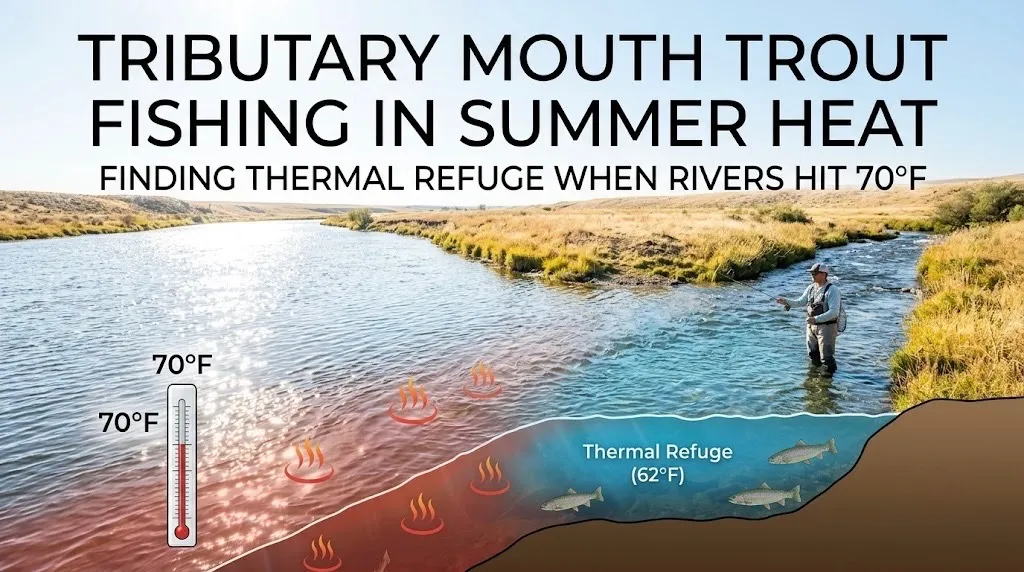
Written by Cameron Spanos
The cleanest tributary mouth I ever found was a culvert. Not a feeder creek, not a marked blue line on the topo. A 24-inch corrugated steel pipe draining a beaver-flooded cedar swamp into a freestone river that was running 71 degrees on the surface. Stick a thermometer six feet down inside the plume and it read 56. There were thirteen brook trout fanned out in a wedge below the discharge, all of them facing into the cold like commuters at a heater vent.
That's tributary mouth trout fishing in summer. It is not glamorous. It is rarely on any map you'd buy. And once you learn to read for it, your July goes from desperate to interesting.
This is the practical "where do I actually go" piece to pair with our earlier water-temperature decision tree on when to stop fishing for trout altogether. If you've already decided the mainstem is too hot to wade up and search-fish, this is how to find the pockets that are still in play, and how to work them without burning out the fish that are stacked there.
Why trout stack at tributary mouths once water hits 68°F
Start with the physiology. Rainbow, brook, and cutthroat trout all begin measurable thermal stress around 68°F (20°C), and brown trout aren't far behind at roughly 70°F. A 2020 literature review summarized in Hatch Magazine argued the long-standing 68°F angling cutoff is actually too generous for most species, recommending 61°F as a stricter threshold for rainbows, brookies, and cutts. One study cited in that review found mortality was 69 percent higher for trout landed in 73°F water versus water under 66°F.
That is the squeeze. Above the upper 60s the fish are working harder, and the water they're working in is holding less of the dissolved oxygen they need to keep working. They can survive a few hours of it. They cannot survive a few days of it without somewhere to dump heat.
So they move. A 2020 study by Wang et al. in River Research and Applications, looking at juvenile steelhead at tributary confluences on the South Fork Eel in California, tracked fish moving into confluence plumes during the warmest hours of the warmest days. Exactly when you'd expect them to. The Wang paper formally defines a thermal refuge as a cold-water patch in the mainstem at least 2.0°C cooler than the surrounding river, fed by groundwater-dominated tributary input. Two degrees Celsius is roughly 3.6°F. That's the floor. The good ones run 10 to 15°F colder than the river they spill into.
Once you internalize that, mainstem geography changes shape. The river is no longer a continuous habitat in July. It is a chain of refuge nodes with a lot of empty water in between.
How do you actually find a tributary mouth on a map?
Topographic maps and satellite imagery before you ever wet a boot. This is the most underrated step.
Open the USGS National Map viewer or CalTopo. Pull up the mainstem you fish. Trace every blue line that joins it, including the dotted blue lines (those are intermittent or seasonal flows, and in June they're often still running). For each junction, ask three questions:
- Where does this feeder originate? A feeder that begins in a high lake or a north-facing canyon notch is more likely to run cold than one draining a sun-baked pasture. Trace it back to its source. If the source is above 7,000 feet in the Rockies, or sits inside a contiguous forest canopy in the Appalachians, you have a candidate.
- How much canopy does it have? Switch to satellite view. A creek that runs under dark green forest for its entire length stays cold. A creek that wanders through open meadows or recent burn scar warms up before it ever reaches the mainstem.
- What's the gradient? Steeper feeders move water through their reach faster, giving the sun less time to heat it. A 200-foot drop in a half-mile creek is your friend.
The Rocky Mountain Research Station's Climate Shield dataset maps streams in the interior West that still meet temperature criteria for native cutthroat and bull trout. It's a free download. If you fish west of the Continental Divide and haven't pulled the Climate Shield layer into Google Earth, you're working blind. For Eastern brook trout water, the U.S. Forest Service and Trout Unlimited's Conservation Success Index covers similar ground at the HUC-12 watershed scale.
The seven kinds of cold plumes (and which ones actually fish well)
Sullivan et al. (2021) in Ecohydrology classified cold-water plumes into seven hydrological types. Knowing which one you're looking at changes how you fish it.
You might also enjoy: Middle Provo River Wade Fishing: Access, Parking, and Hatches Mile by Mile
- Tributary confluence plume. The classic. A named creek dumps into the river and creates a wedge of cooler water downstream of the mouth. Easy to find, often pressured, but the bigger ones can hold dozens of fish.
- Lateral spring or seep. No tributary involved. Groundwater emerges directly from the bank, often visible as a wet stripe of moss or a slow, cool boil in the slack water against the riprap.
- Springbrook. A short, cold side-channel fed by groundwater that rejoins the mainstem within a few hundred yards. The mouth fishes like a confluence plume but the source isn't a watershed, it's an aquifer.
- Side channel. A braided channel that carries mainstem water but runs shallow, shaded, and slow enough to stay 2 to 4 degrees cooler than the main thread.
- Alcove. A still pocket cut into the bank, fed from below by hyporheic exchange. These look like nothing. They fish like everything.
- Wall-base channel. A trickle that runs along the toe of a bluff, fed by water moving laterally through gravel.
- Hyporheic upwelling. Diffuse groundwater bubbling up through the streambed itself. Often invisible from the surface. The way you find them is by wading and noticing a cold ribbon around your shins.
If you're new to this, work the tributary confluence plumes first. They're the easiest to find and they hold the most fish. The lateral seeps and the hyporheic upwellings are the ones nobody else knows about and they're where the actual specimen fish often park.
Late-June scouting: what to do before the river goes dire
This is the part most anglers skip and then regret in mid-July. The scouting window is roughly the last two weeks of June into the first week of July in the Mountain West, slightly earlier in the East and Upper Midwest. The water is still cool enough to wade and search-fish, but it's warm enough that the cold seeps already show up as obvious temperature breaks.
What you're doing is building a list. Not catching fish. Carry a stream thermometer. A cheap dial-face one from a fly shop is fine. The Fishpond Swift Water thermometer is the one I see most guides clipping to a zinger.
Wade a half-mile section. Take a reading in the middle of the river every 100 yards. When you cross a tributary mouth or pass a slack-water spring pocket, take the reading right in the plume. Six inches under the surface, and again on the bottom if you can reach it. Anything 3°F cooler than the mainstem reading goes in your notes with a pin drop. Anything 5°F cooler is a top-tier spot.
Look for the ecological signatures while you're at it. The Hatch Magazine winter-seep article makes this point about cold-season scouting, but it works in reverse in summer: lush green ferns, watercress, and skunk cabbage clinging to a bank in mid-July when everything else is brown means groundwater is exposing itself there. So does a band of unfrozen water in February. You can scout those signatures any time of year. They don't move.
By the time the mainstem is locked at 72°F in late July, you should have eight to fifteen refuge spots flagged across your home water. That's your hot-weather quiver. Without it, you are guessing.
Fishing the mixing zone without burning out the fish
Here's where the ethical knife edge sits. Trout in a refuge plume are concentrated, stressed, and at their thermal limit. They will bite. They will also die more readily if you fight them too long, land them in 73°F water, or wade through the plume and spook them out into the warmer mainstem they just escaped.
I do not fish the plume itself. I fish the mixing zone: the seam where the cold tributary current shears against the warmer mainstem flow, downstream of the actual mouth. The fish that are willing to feed will hold there, on the warm-water edge of the cold, intercepting drift that gets pushed across the temperature break. The fish that are too stressed to feed stay deeper in the cold core. Those are not your fish today.
A few rules I run by:
- Fish dawn only. Water temperature lags air temperature by hours. The river is coldest between roughly 4 a.m. and 9 a.m. By noon you should be done. The Idaho Department of Fish and Game's summer guidance recommends the same window.
- Check the temp in the plume itself, not the mainstem. If the plume is reading above 65°F, leave. The refuge has already been overrun.
- Land fish fast. A 4X tippet on a 5-weight ends a fight in 30 seconds on a 14-inch fish. A 6X tippet ends it in two minutes. Pick the heavier line.
- Keep the fish in water for the unhook. Forceps, barbless hook, no air time, no grip-and-grin photo.
- Do not wade into the refuge. Cast from the bank or from the mainstem side of the seam.
If you find a stack of 20 fish wedged into a 30-foot pool below a feeder mouth, the right answer is sometimes to take one drift, hook one fish, and walk. Hammering a refuge for an afternoon is the closest thing to clubbing fish that legal angling allows.
You might also enjoy: Fly Fishing Utah for Beginners: 5 Forgiving Rivers
What fly to throw at the seam
Match the mainstem hatch, not the tributary's. The fish are eating drift that's coming down the big river. The cold feeder is rarely producing meaningful bug life of its own at this volume. In most freestone systems in mid-summer that means terrestrials on top (ants, beetles, hoppers once it's hot enough) and a small attractor nymph below.
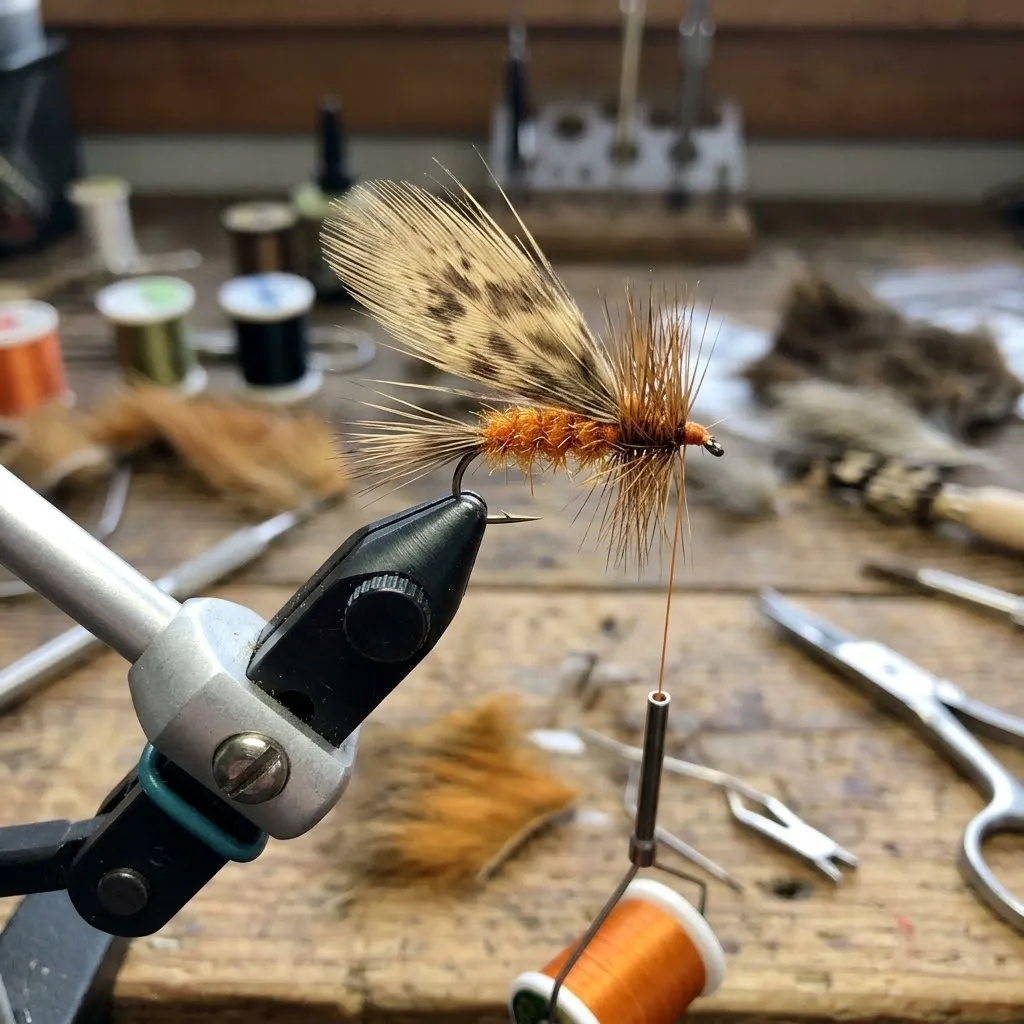
A size 14 Chubby Chernobyl with a size 16 Pheasant Tail on a 24-inch dropper has caught me more refuge-stacked fish than anything else I've tried. The seam is usually narrow enough that you need a tight drift, not a long one. Cast across, mend once, let it swing the last foot through the temperature break.
Streamers fish poorly in the plume itself because the fish are not in feed-aggressively mode. They are in survive-the-day mode. A small swung soft-hackle moves more fish than a slammed sculpin pattern at this temp.
You can log every refuge spot and the water temps you recorded directly in Bushwhack. The seasonal patterns view will tell you a year from now which plumes held up in a drought summer and which one disappeared when flows dropped below a threshold. That intel compounds.
Are tailwaters cheating?
A bit. They are also, in 2026, the most reliable trout water in the Lower 48 in July.
A tailwater is the section of river below a bottom-release dam. Cold reservoir water gets pulled from the hypolimnion and released at temperatures often in the high 40s to low 50s year-round. The Bighorn, the Green below Flaming Gorge, the South Holston, the San Juan, the Madison below Hebgen, the Farmington in Connecticut. These rivers are functionally one giant thermal refuge for 30 to 50 miles downstream of the dam.
The contrarian take: a lot of anglers default to tailwaters in July because they're easy, and ignore that the most interesting summer fishing is on a hot freestone with a half-dozen scouted tributary mouths. Tailwater trout in July aren't stressed. Freestone refuge trout are, which means smaller windows, smarter casting, and harder-earned fish. If you want a trip you'll remember, fish the freestone refuges at dawn. If you want to catch a lot of fish without thinking, drive to the tailwater.
When to give up on the refuge and switch species
If you wade in at dawn and the plume is reading 67°F, the refuge has been compromised. Usually that means the mainstem is so warm the cold input can't dilute it down anymore. That has happened more often each of the last four summers on the freestone water I fish.
The honest move at that point is to put the trout rod away and go bass fishing. Smallmouth are happy at 78°F. Largemouth thrive at 82°F. Bluegill don't even notice. The same river that's lethal for brown trout in August is fishing well for smallmouth in the same week. Switching species is not a failure of trout angling. It is the floor of what conservation-minded angling looks like in a warming climate.
Build the refuge list in June. Fish it ethically at dawn. Walk away when it stops being safe. The trout will be back when the water turns over in September.
Get fishing tips in your inbox
New guides, seasonal tactics, and gear picks — about once a month, no spam.