Is a Tenkara Rod Worth It for American Trout Streams in 2026? Mizuchi vs Hellbender vs Tenryu
 Cameron Spanos
Written by Cameron Spanos
Three rejected casts on a brushy Catskills feeder, line snagged in rhododendron twice on the back-cast, and a 9-inch brookie that ate before the dry even landed. That was the moment I stopped pretending my 8-foot 3-weight was the right tool for a creek I could jump across. The next trip I borrowed a tenkara rod.
So is a tenkara rod worth it for American trout streams in 2026? For a specific kind of angler on a specific kind of water, yes. For everyone else, no. This piece compares three rods, addresses the three big objections, and tells you who should buy in and who should stick with their 5-weight.
Quick Picks: Three Rods That Define the Tenkara Buying Decision
| Rod | Best For | Price | Rating |
|---|---|---|---|
| Dragontail Mizuchi zx340 | Tight small streams, brookies, hike-in creeks | ~$160 | 4.5/5 |
| Dragontail Hellbender | Bigger trout, light streamers, warmwater crossover | ~$160 | 4.6/5 |
| Tenryu Furaibo TF39 | Anglers who want the genuine Japanese article | ~$340 | 4.5/5 |
The Mizuchi is what most American small-stream anglers should buy. The Hellbender handles bigger water and warmwater crossover. The Furaibo is the splurge for anglers who already know tenkara is for them.
What Tenkara Actually Is (and What It Isn't)
Tenkara is a Japanese fly-fishing method that uses a long telescoping rod, a fixed-length line tied directly to the rod tip, a tippet, and a fly. No reel. According to Tenkara USA, the method was developed by professional commercial anglers in the mountain streams of Japan who needed to catch fish efficiently in tight, brushy water. Modern rods run 11 to 13 feet, collapse to 14 to 25 inches, and weigh 2.5 to 3.5 ounces.
It is not a gimmick. It is also not a replacement for fly fishing on water bigger than a high-school gym.
The reach a 12-foot rod gives you on a creek 15 feet wide is the entire point. You hold the line off the water, the fly drifts drag-free, and you don't have to mend. That is a presentation advantage in pocket water no western rod can match. The flip side is just as real: fixed-line casting, no stripping a streamer, and a 16-inch rainbow turns into a rodeo.
Does Tenkara Actually Work Better Than a 5wt on Small Streams?
For creeks under 25 feet across with overhead canopy, yes. With a western rod and floating line, every foot of fly line on the surface is a foot of drag waiting to ruin your drift. With a 12-foot tenkara rod and a level line slightly longer than the rod, you can put a fly on a dinner-plate seam behind a midstream rock and let it sit in dead-drift purgatory until the trout snaps.
Where it stops working: open water. Once you're fishing a river you can't reach across with the rod plus 14 feet of line, tenkara starts giving up ground. You can rig long lines, but you're better off with a fly rod stripping running line.
Backpacking is where the math gets ridiculous. A Mizuchi plus level line, a small fly box, tippet, and nippers comes in under 6 ounces. A 4-piece 4-weight in a tube with reel, line, backing, leader, and tippet is closer to 18 ounces. On a multi-day, that delta is real.
The Three Big Objections (and Whether They're Right)
"There's no reel."
True. Also overrated on small-stream water. On a 25-foot creek where fish average 8 to 14 inches, you don't need a reel. You hand-line them in. The long soft rod absorbs the headshakes. The argument that you need a reel is mostly an argument that you fish for bigger fish than tenkara is built for. Fair. Buy the right tool.
"I can't change the line length."
Sort of true. You can swap spools between sessions in two minutes. You cannot adjust on the fly the way you can by stripping line off a reel. The zoom rods help by giving you three rod lengths to match the line, but rod-length-plus-a-foot is the rule. The constraint forces better water-reading.
"What if I hook a big fish?"
The rods are designed to break before the line does. That sounds bad. It is, in fact, the point. The high-modulus carbon flexes deep and loads evenly. The Hellbender was built specifically for fish in the 16-to-22-inch range, and reviewers at Tenkara Angler have landed 12-to-15-pound carp on it. If your water has trout regularly over 18 inches, that's the rod. If it doesn't, the lighter Mizuchi is more fun for the typical fish.
You might also enjoy: Best All-Around Trout Fly Rod 2026: Sage R8 Core vs Orvis Helios vs Scott Centric vs Douglas Sky G
Dragontail Mizuchi zx340: The Default American Small-Stream Rod
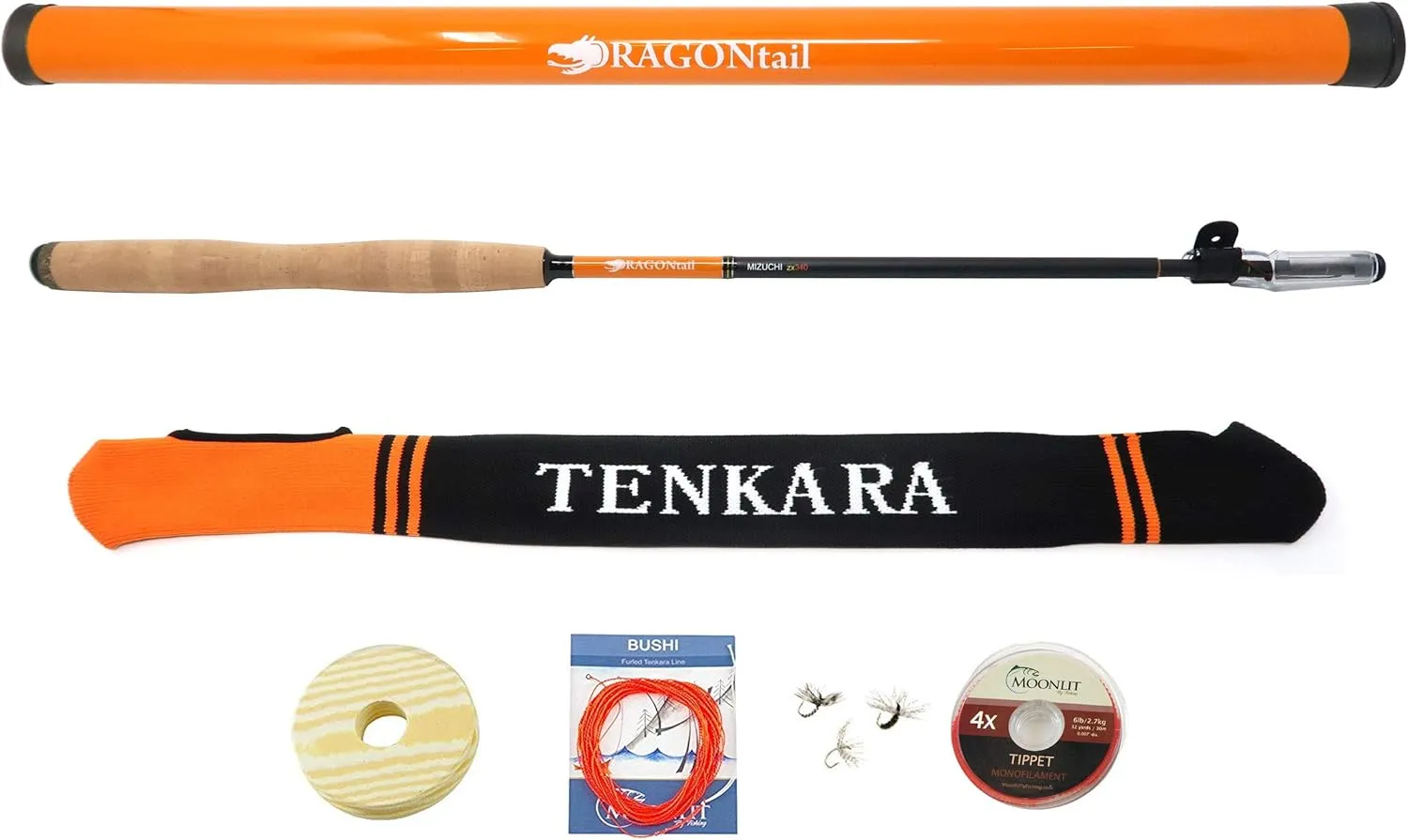
This is the rod I'd put in the hand of any western angler trying tenkara without buying twice. Three-length zoom: 7'10", 9'7", 11'2". Closed length 25 inches. Weight 2.86 ounces.
The shortest length is what earns the rod its keep. On a creek with a tight rhododendron tunnel where you can't get a back-cast off, the 7'10" setting fishes in places a 12-foot rod simply cannot go. Roll casts and bow-and-arrow casts most of the time, but you're catching fish in water nobody else can reach because nobody else has a tool short enough to fit.
Who it's for
- Creeks under 20 feet wide with overhead canopy
- Backpackers fishing alpine trout lakes and tributaries
- One rod that handles a 6-inch brookie creek and an open headwater
Pros and cons
- Three lengths from one rod is useful, not marketing
- Backbone is a real surprise; hook sets are decisive at the short length
- Dragontail's $60 one-time replacement warranty is the best in the segment
- Cork handle is fine but not premium
- Learning curve at the longest length in wind
Buy the Dragontail Mizuchi zx340 if you fish small-stream trout water and want a rod that won't be the limiting factor on any creek narrower than your driveway.
Dragontail Hellbender: When Trout Get Bigger or You Want to Cast Streamers
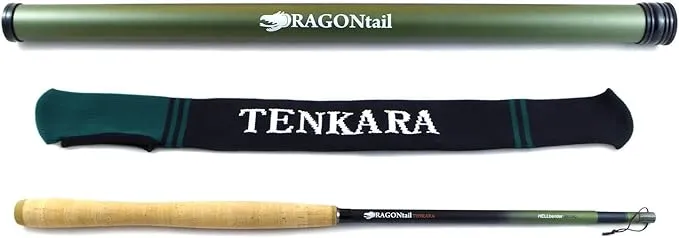
The Hellbender converts skeptics. Two zoom lengths (11'2" and 12'9"), 7:3 action, IM12 carbon, just over 3 ounces. Tippet-rated to 3X, but reviewers report fishing 2X without breaking it.
This is the rod for tailwaters where you'll regularly hook 16-to-20-inch rainbows, and for warmwater anglers using tenkara on smallmouth and largemouth, where bigger flies and harder-fighting fish demand more backbone than a small-stream rod offers.
Tom Davis at Tenkara Angler called it "a fantastic all-around rod" and used it for tight-line nymphing as well as conventional tenkara. Hook sets are fast. Casting stroke is moderately quick: slower than a fast-action western rod, faster than a soft Japanese tenkara stick.
Who it's for
- Water with regular 16-inch-plus trout
- Bass anglers wanting to try tenkara on smallmouth or largemouth
- One tenkara rod for both trout and warmwater species
Pros and cons
- Backbone for fish a small-stream rod can't handle
- Casts heavier flies (small streamers, weighted nymphs) better than soft-action rods
- Slightly tip-heavy at 12'9" compared to softer rods
- Overkill for genuine 8-to-12-inch brookie creeks
Pick up the Dragontail Hellbender if your water has fish that would worry you on the Mizuchi.
Tenryu Furaibo TF39: The Premium Japanese Option
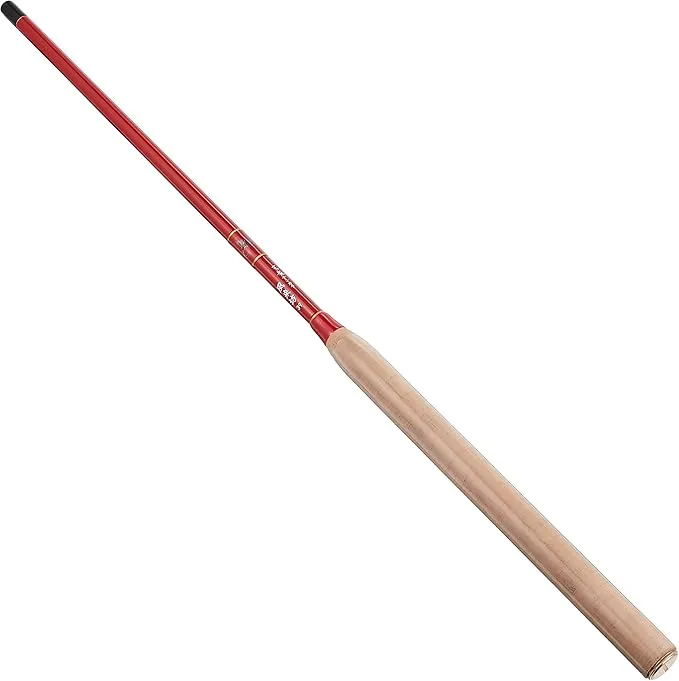
The Furaibo is what tenkara feels like when a Japanese rod-builder takes the form seriously. 12'10" mid-flex (the TF39TA zoom fishes 11'0", 11'11", 12'8"), red-lacquered finish, 71 grams, 83/17 carbon-to-glass. Collapses to 14 inches.
Reviewers describe the casting stroke as "smooth as silk." The bend profile is even from tip to butt. The handle is cylindrical and narrow, which is divisive. American anglers raised on western cork find it thin. Japanese tenkara anglers find it correct.
Is it three times the rod the Mizuchi is? No. Is it the best-feeling rod in the comparison? By every account I've read, yes. If you've fished tenkara for a season and you know it's the method for you, this is what you graduate to. If you haven't, start cheaper.
Who it's for
- Anglers who own a budget tenkara rod and know they'll keep fishing it
- Buyers who care about Japanese craftsmanship
- Anglers on larger trout water who value feel over backbone
Pros and cons
- Casting smoothness is a step above the Dragontail rods
- Build quality is noticeably better than American imports
- Handle is narrower than most Americans prefer
- Tippet rating limits you on bigger fish vs the Hellbender
The Tenryu Furaibo TF39 is the rod for the tenkara angler who already knows.
You might also enjoy: Best Summer Bass Lures for 2026: Topwater, Prop Baits, and Vibrating Jigs
What to Look For When Choosing a Tenkara Rod
Four specs matter. The rest is noise.
Length and zoom. Match rod to water. Under 15 feet wide with canopy: a rod that zooms down to 8 feet earns its keep. Open headwater 25 to 40 feet wide: a 12-to-13-foot rod. Zoom rods are not a gimmick; they let one rod cover two creeks.
Action. Tenkara actions are 5:5, 6:4, 7:3, or 8:2 (the ratio of where the rod bends). A 7:3 is faster, sets hooks quicker, casts heavier flies better. A 5:5 is the classic tenkara feel, casts unweighted kebari beautifully, and protects light tippets.
Closed length. If the rod goes in a backpacking pack, this matters. Most rods collapse to 18 to 25 inches; the Furaibo's 14 inches is shorter than most. If you're never hiking with it, ignore this.
Warranty. Tenkara rods break. Dragontail's one-time replacement for $60 plus shipping is the best in the segment. Tenryu rods break less, but when they do, parts are harder to source in the US.
Who Should Skip Tenkara Entirely?
If you fish rivers wider than 40 feet, buy a 5-weight. If you fish trout that regularly exceed 20 inches, buy a 5-weight. If your favorite technique is swinging streamers, stripping leeches, or fishing weighted articulated flies, buy a 6-weight. If you've got an indicator nymphing setup dialed, you don't need tenkara. Tight-line nymphing with a euro rod gets you everything tenkara offers on bigger water plus the ability to fight a 22-inch brown without running downstream.
Tenkara is right for the angler who fishes brushy small creeks, hikes into mountain water, or wants to simplify to one rod, one line, one fly. It is wrong for the angler fishing broad rivers with a wide range of techniques.
Our Pick: The Dragontail Mizuchi
One rod, have to pick: buy the Dragontail Mizuchi zx340. It does the most American trout-stream tenkara fishing well. Three-length zoom genuinely matters. Price is friendly to first-time buyers. Warranty is the most generous in the segment. It'll handle every fish you're realistically going to catch on a creek you can step across.
Fish bigger trout or want a bass crossover: the Hellbender. Already fished tenkara and want to upgrade: the Tenryu Furaibo.
Once the rod is in your hand, the rest is water-reading. Logging the creeks where each rod earns its keep, the lengths that work, the flies that move fish: that's where the real learning is. Try Bushwhack to track which water and which rod produced your best days. The patterns surface fast once you have a season logged.
Get fishing tips in your inbox
New guides, seasonal tactics, and gear picks — about once a month, no spam.