June Smallmouth Bass: How to Fish the Three Stages from Spawn to Summer
 Hudson Reed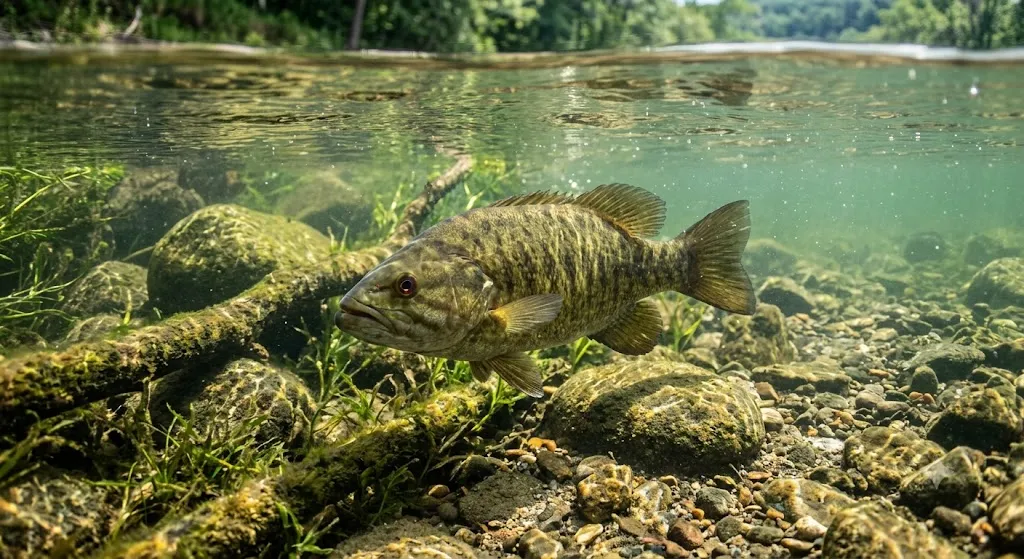
Written by Hudson Reed
By the second week of June, a single point on a clear-water lake will hold a four-pound post-spawn female on the 15-foot break, a fry-guarding male in four feet of water on the same point, and a late-spawning male still bedded in two feet of water 30 yards down the shoreline. Same point. Same hour. Three completely different fish on three completely different programs. That's June smallmouth bass in one paragraph.
Most articles treat the spawn like a single event you fish through. It isn't. By mid-June across most of the smallmouth belt, the population has split into three groups that behave like three different species, and if you're throwing one lure at all of them you're cherry-picking one stage and ignoring the other two. Get the stages right and a tough day turns into a 30-fish day. Get them wrong and you blame the weather.
The three June stages, explained
Across a single lake or river system in June, smallmouth occupy three overlapping life stages at the same time:
- Stage 1 (late spawners still on beds). These are males, plus a smaller number of late females, still locked to a nest in 2–8 feet of water. They strike from territoriality, not hunger.
- Stage 2 (fry-guarders). Males whose eggs have hatched, now shepherding a black cloud of fry just off the original bed for 12 to 16 days, per the USGS and multiple state agencies. These fish eat reactively when small intruders threaten the fry.
- Stage 3 (post-spawn movers). Recovered females and spent males pulled off the beds and staged on the first hard-bottom break in 7–20 feet. They're tired for a few days, then ravenous.
The Game & Fish article that popularized the "three phases" framing for June smallmouth treats them as a sequence you fish through chronologically. Out on the water, that's not how it works. They're concurrent, not sequential. A single point on a lake will hold Stage 2 males in four feet and Stage 3 females on the 15-foot edge of the same point at the same time on the same Tuesday.
Mapping spawn timing by latitude and full moon
Smallmouth spawn most heavily on the full or new moon when water temperature has held in the 60–65°F window for several consecutive days. Wisconsin DNR puts the typical Wisconsin spawn at 62–64°F, with documented activity as low as 53°F and as high as 75°F. That's a wide window, and it's why smallmouth spawn looks staggered even within a single lake.
Rough latitude map for 2026:
- Tennessee, Arkansas, Oklahoma: peak around the April full moon (April 22); most fish off beds by mid-May.
- Kentucky, Missouri, southern Indiana: peak on the early-May full moon; most fish off by late May.
- Mid-Atlantic rivers (Susquehanna, Potomac, James): mid-May through first week of June. By June 15 most males are fry-guarding.
- Great Lakes, northern Wisconsin, Minnesota, New York Finger Lakes, New England: peak on the June 1 new moon and June 20 full moon in 2026. This is the latitude where all three stages stack hardest in the same month.
- Lake Superior, Boundary Waters, northern Ontario: peak late June into the first week of July. June 20 is the spawn full moon here, and water doesn't always hit 75°F at all in some bays.
The moon doesn't override temperature.
If water is still 56°F on the full moon, you don't get a wave. But when the moon and temperature line up, you get a heavy synchronized push, and the calendar week after that is when Stage 2 explodes. This is the part most anglers miss: the moon is a trigger, not a switch. It pulls a wave of bedded fish onto nests when conditions are already close, and it does almost nothing when conditions aren't.
Why is June smallmouth fishing so frustrating for most anglers?
Because the lure that crushed yesterday's pre-spawn stagers is wrong for at least two of the three stages today. A jerkbait pulled four feet off a Stage 1 bed in clear water will move the male off the nest and not get bit. A Ned rig dragged through a Stage 2 fry cloud will catch the guarder, but it's a 14-inch fish when the 4-pound female is sitting on the offshore rock 80 feet away. And a topwater walked over 18 feet of water in 64°F surface temp does nothing because the post-spawn fish aren't committed to the surface yet.
You have to read which stage you're fishing before you pick the lure. Not the other way around.
You might also enjoy: 2026 Fishing Regulation Changes Every Angler Should Know
Stage 1: late bedders
You'll know it because you can see them. Polarized glasses, a calm afternoon, and any shallow rock or sand flat with scattered gravel between 2 and 8 feet. A bedded male is the size of a dinner plate, usually facing into a depression he's fanned clean.
Best presentation: a small tube (3-inch, green pumpkin) or a Ned rig on 1/10-ounce, dragged through the bed and left to sit. The strike is territorial. He'll pick it up and try to carry it out of the nest. Set on weight, not movement. If the local water is over 70°F by mid-June, almost no smallmouth will still be locked on a bed, so this stage shrinks fast in warmer latitudes.
One unpopular opinion: I don't fish for visible bedded females. Hooking and stressing the female that just laid eggs on a nest she'll abandon is a worse trade than catching one less fish. Bedded males are different. They go right back on the nest within a minute of release and the eggs are still guarded. The Quebec MFFP and several state agencies (Minnesota and Vermont both go further with seasonal closures) treat this distinction seriously, and so should anyone hoping to fish the same water in 2027.
Stage 2: fry-guarders
This is the easy money stage and the one most anglers under-fish. The eggs hatch in 4–5 days at typical spawn temps and in under 48 hours when water hits 70°F, and then a tight black cloud of fry rises above the nest. The male guards that cloud for roughly two weeks.
Find the cloud, find the fish. Fry look like a black smudge or shadow on shallow rock from a distance of 10 feet. They move as a unit. A male is always within a rod-length of them.
Lure rotation for fry-guarders:
- Small popper (Rebel Pop-R 5/8 oz, Heddon Tiny Torpedo): cast past the fry cloud and chugged through it. Imitates a bluegill or sunfish trying to eat fry. The male crushes it.
- 3- to 3.5-inch swimbait on a 1/8-oz jighead. Same idea: fry predator profile.
- Small spinnerbait, 1/4 oz, white-and-chartreuse double willow. Slow-rolled past the cloud. Old-school but lethal.
Pitch the lure beyond the cloud and bring it through, not at it. A bait that drops directly on the fry triggers the male to attack from below, and you'll miss the hookset because the fish hit upward.
Stage 3: post-spawn movers
The fish that already finished (recovered females especially) pull off the beds and stack on the first sharp structure with deep-water access. On lakes that's a chunk-rock point dropping into 12–20 feet, an isolated boulder pile on a flat, or the deep edge of a weed line. On rivers it's a current seam below a midstream boulder or a deep pool tail-out.
The first few days off the bed, these fish are tired. They eat slow. A Ned rig (Z-Man Finesse TRD on a 1/6-oz mushroom head) or a drop-shot with a 4-inch finesse worm shaken in place will catch them when nothing else will. Three pounds of fish is the rule, not the exception, once you find a school.
You might also enjoy: Best Fishing Pliers Under $50 for 2026 (Aluminum vs Stainless, Saltwater-Ready)
After about a week of recovery, the same fish flip aggressive. This is where most of June's biggest bites come from. Now you can speed up:
- Suspending jerkbait (Megabass Vision 110+1, Rapala Shadow Rap): snapped erratically on 8-lb fluorocarbon. Long pauses.
- Swimbait on a 3/8-oz head: retrieved just under the surface across the break.
- Topwater once surface temp clears 75°F. The Whopper Plopper 110 and Berkley J-Walker 120 are the two I'd take if I could only carry two.
When does topwater really turn on?
Anglers throw topwater all of June. It works occasionally. It catches absolutely everything once surface temp holds at 75°F for three consecutive days.
That's the threshold I've watched flip hundreds of trips. Below 75, smallmouth will rise for topwater in low light but commit poorly the rest of the day. At and above 75, they crush walking baits and plopper-style lures across the middle of the day, in the middle of the lake, over 20 feet of water. The Bassmaster guidance and multiple guide reports converge on the same number, and it lines up with the temperature where smallmouth metabolism is fully ramped and they want to chase down baitfish at the surface rather than ambush from depth.
In the smallmouth belt that 75°F line typically hits:
- Mid-Atlantic rivers: first week of June
- Ohio Valley reservoirs: second week of June
- Great Lakes shallow bays: late June to early July
- Boundary Waters and Lake Superior shoreline: not until mid-July, and on cool years sometimes not at all
What lure do I tie on first?
If I'm walking into a June lake cold, no intel, no electronics scan yet, here's the rotation that pulls the most information out of the water in the first hour:
- Start with a Ned rig on the first hard-bottom break out from a known spawning flat. If you catch a tired female in 12 feet, you're on Stage 3 recovery fish; slow it down.
- If the Ned rig dies after a fish or two, swap to a jerkbait on the same break. If the jerkbait gets eaten, the fish are aggressive post-spawn. Speed up further.
- Move shallow. Idle the flat looking for fry clouds and bedded males. If you spot a cloud, pop a small topwater past it.
- If the surface temp has cleared 75 and there's any wind on the main-lake points, start throwing a walking topwater across deeper structure. This is where the biggest fish of June live.
Track which stage produced. Write it down. You can log catches with the water temperature in Bushwhack and have the pattern by next June without trying. The fish do the same thing every year within a 7–10 day window of the moon, and the angler with three Junes of logged data smokes the angler going off memory.
Common mistakes that kill a June smallmouth day
A short list, mostly mine:
- Fishing one stage all day. If the shallow bite dies at 10 a.m., it didn't die. You moved past the bedders and into Stage 3 water without changing lures. Switch.
- Ignoring fry clouds. They look like nothing. They are the highest concentration of catchable fish in the lake.
- Throwing too big. Stage 2 males want small, fry-sized profiles. A 5-inch swimbait gets refused; a 3-inch one gets eaten.
- Chasing the full moon literally. The bite is best the three days before and after a full or new moon, not the moon night itself. Dialing in lunar timing matters; treating it as a single magic date doesn't.
- Quitting at 75 degrees. The week the lake first holds 75°F is the best week of the year for catching a personal-best smallmouth on topwater. Don't put the boat away for the "summer slump" until July.
The summer slump is real, but it doesn't start in June. June is when all three stages overlap, the fish are eating to recover weight, and the topwater window cracks open. There is no better month of the year for a smallmouth angler willing to read what's actually happening on the water and adjust the lure to match.
Get fishing tips in your inbox
New guides, seasonal tactics, and gear picks — about once a month, no spam.