How Deep to Set Your Indicator in Winter, and How Much Split Shot to Use
 Cameron Spanos
Written by Cameron Spanos
Ask around about how deep to set your indicator and nearly every source hands you a different number. MeatEater and Orvis say about 1.5 times the water depth. Jackson Hole Fly Company says 1.5 to 2 times in winter. The Fisherman says depth plus 6 inches. The Catch and The Hatch says it hangs on current speed and can run anywhere from 1.25 to 3 times.
None of them is wrong. They just aren't measuring to the same point on the leader, or talking about the same water.
My short version for December through February: in the slow, deep runs where winter trout sit, put the indicator about 1.5 times the depth above your split shot, resist the urge to go longer, and when the rig isn't getting down, reach for another shot before you reach for more leader. Everything below is how to tell which of the two you're actually short on.
A few inches too high is a wasted drift in January
In summer a trout will slide a foot up or sideways for a nymph. In cold water it mostly won't. Carrianne Pershyn of the Ausable River Association, writing for Lake Champlain Sea Grant, describes winter trout holding in "deep pools and long runs with slower velocities," with a metabolism that has dropped far enough to let them go longer between meals. They still eat drifting insects. They just try to spend as little energy as possible doing it.
Murray's Fly Shop puts the fishing consequence bluntly in its winter nymphing notes: depth matters more than pattern, and a fly riding even a few inches too high may never get looked at.
So the slop you get away with in July is gone. Depth and weight are the whole game now, and the fly is a distant third.
How deep to set your indicator: the rules side by side
Here are the starting rules you'll run into, with what each one does to a run that's 4 feet deep.
| Rule | Measured from the indicator to | Who says it | In 4 feet of water |
|---|---|---|---|
| 1.5x depth | The fly | MidCurrent | 6 feet to the fly |
| 1.5x depth | Not spelled out | Orvis, MeatEater | 6 feet |
| 1.5x depth | The split shot | Guide Recommended | 6 feet to the shot |
| 1.5x to 2x depth in winter | Not spelled out | Jackson Hole Fly Company, Murray's Fly Shop | 6 to 8 feet |
| Depth plus about 6 inches | The split shot | The Fisherman, California Fly Fisher | 4.5 feet to the shot |
| 1.25x slow, 1.5x medium, up to 3x fast | The split shot | The Catch and The Hatch (its classic-nymphing article) | 5 feet slow, 6 feet medium |
Two things explain nearly all of the disagreement.
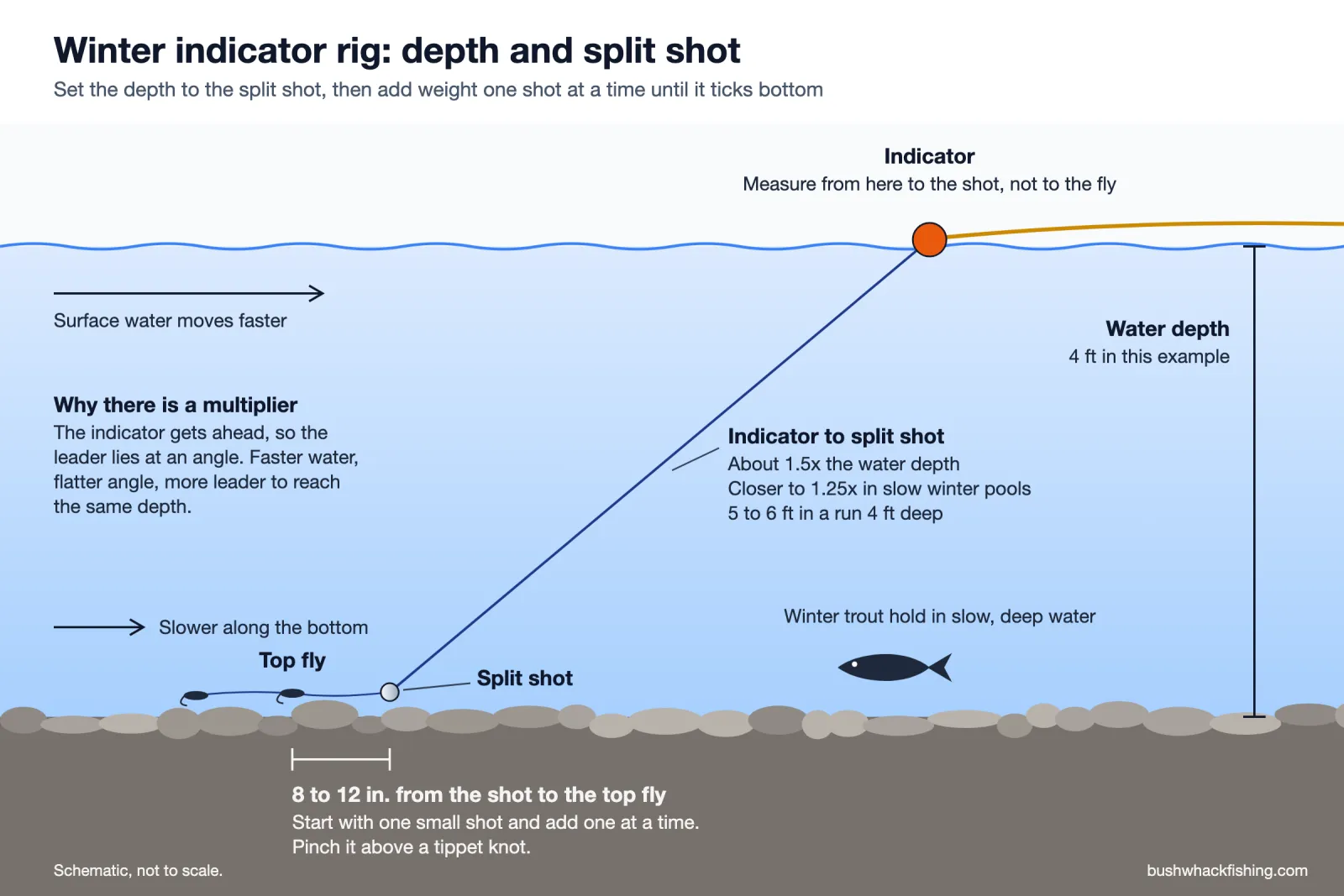
First, the measuring point. If your shot sits 10 inches above the top fly, "1.5 times to the fly" and "1.5 times to the shot" are two different rigs, nearly a foot apart. I'd measure to the shot every time. The shot is the part that finds the bottom, and the flies trail along behind it at whatever depth it's riding.
Second, current speed. The reason there's a multiplier at all is that your leader doesn't hang straight down. Water at the surface moves faster than water along the bottom, so the indicator gets ahead and the leader lies at an angle. The faster the run, the flatter that angle and the more leader it takes to reach the same depth. That's why The Catch and The Hatch's classic-nymphing article scales its number with speed, and why The Fisherman's depth-plus-6-inches rule (its own example is a 42-inch drop in 3 feet of water) works fine in slow water where the leader hangs close to vertical.
Which leaves the winter rule looking backwards. Winter trout are in the slowest water in the river, and slow water needs the smallest multiplier. So why do Jackson Hole Fly Company and Murray's both tell you to go as far as 2 times?
Because most of us underestimate depth in a dark winter pool, and most of us fish too little weight. A long leader papers over both. It also puts a lot of slack between the indicator and the flies, and a cold trout doesn't yank anything. It stops the fly for half a second and lets go. With 8 feet of leader wandering around in 4 feet of slow water, that take never reaches the surface.
You might also enjoy: Rio Powerflex Plus vs SA Absolute vs Umpqua Perform X: Best Tippet for Winter Midges in 6X and 7X (2026)
That's my one stubborn opinion on this: in slow winter water, 2 times depth is a patch for a rig that needed another split shot. Start at 1.25 to 1.5 times to the shot, and go longer only when the current picks up or the pool turns out deeper than you guessed. (Reds Fly Shop on the Yakima teaches the opposite, setting the indicator a couple of feet deeper than the target and controlling depth with mends. Good menders in pushier water can make that work. Most of us can't mend that well with frozen fingers.)
Where does the split shot go?
Eight to 12 inches above the top fly covers most winter water. That's the range both MidCurrent and Orvis give, and MidCurrent spells out the reasoning: too close and the flies bounce unnaturally or snag, too far and they may never get down to the depth the shot is riding at.
Not everyone lands there. Murray's Fly Shop goes a little tighter for winter, at 6 to 10 inches above the top fly. California Fly Fisher goes the other way and leaves about 18 inches between the shot and the first fly.
Short and long both have a place. A size 20 midge larva with no bead has nothing to sink it but that shot, so in winter I'd keep it at 8 to 10 inches and accept a little less freedom in the drift. Go out to 14 or more when the water is slow and clear enough that you think the shot itself is putting fish off, or when the fly below it carries its own tungsten bead and doesn't need the help.
Pinch the shot above a tippet knot. Otherwise it slides down to the fly by the third cast and you've changed your rig without knowing it.
How much split shot is enough?
Start with one small shot and add one at a time. MidCurrent's guide to weighting a nymph rig says outright that there's no formula along the lines of two shot per foot of depth, but it does offer bookends: a single small shot for a 2-foot riffle or a 4-foot run with moderate flow, and a BB plus a No. 4 for a 6-foot pool with heavy current.
It helps to know what those sizes weigh. By the sizing Orvis lists for its non-toxic shot, a No. 6 is 0.1 gram, a No. 4 is 0.2, a No. 1 is 0.3, a BB is 0.4 and an AB is 0.6. One BB equals four No. 6 shot. That's why I'd carry two sizes and no more: a BB for getting close in a hurry and a No. 6 for the last adjustment. With only BBs in your pocket, every change is a big one.
Ed Engle's line, which MidCurrent quotes, is still the best single instruction anybody has written on the subject: "Add weight until you hang up, then remove just a little bit."
A few details change how much you need. Space multiple shot an inch or two apart so they cast as a string and not a lump. Thinner tippet sinks faster, and MidCurrent reckons dropping from 4X to 6X can matter about as much as adding another shot, which is handy since winter midges want fine tippet anyway. And check the rules before you buy: Yellowstone, for one, requires lead-free tackle, and the park's fishing page is the place to confirm what's legal there. Tin and tungsten shot are sold in the same sizes.
The one-change-at-a-time routine
Most depth problems come from changing two things at once and not knowing which one worked. This is the order I'd run it in.
You might also enjoy: Dry Dropper Rig Setup: A Complete Beginner's Guide
Step 1: Guess the depth, then rig to the shot
Estimate the deepest part of the lane you want to fish, and be pessimistic about it, since dark water runs deeper than it looks. Set the indicator 1.25 to 1.5 times that depth above the shot. Your rod is the ruler: 6 feet is two thirds of a 9-foot rod.
Step 2: Put on one shot, 8 to 10 inches up
One. Even if you're sure it needs three.
Step 3: Make three clean drifts and watch for a tick
Cast farther upstream than feels necessary so the rig has time to sink before it reaches the fish. MidCurrent's target is the weight touching bottom every few drifts, a tick and not a plow.
Step 4: No tick? Add a shot, not leader
Add one small shot and make three more drifts. Repeat until the indicator hesitates somewhere in the run. Only when you've added three or four and still feel nothing should you suspect the pool is deeper than you thought and slide the indicator up 6 inches.
Step 5: Hanging up every cast? Back off one notch
Take off the last shot you added. If you're still dragging, slide the indicator down toward the flies 6 inches at a time.
Step 6: New run, start over
The setting that was perfect in the pool is wrong in the tailout below it. Winter fish are concentrated enough that you'll only fish a few spots in a day, so re-rigging at each one costs you five minutes, total.
What is a dragging or stalling indicator telling you?
The indicator is a depth gauge before it's a strike detector. Watch it against the bubbles and foam drifting next to it.
- It keeps pace with the bubbles and never hesitates. Your flies aren't down. A rig that's in the slow water near the bottom acts as a brake, so a properly weighted indicator travels a touch slower than the foam beside it. Add a shot.
- It stutters or ticks once every few drifts. You're there. Change nothing, and set the hook on anything that looks different from a tick.
- It stalls, leans upstream and sinks slowly in the same place every drift. That's the bottom, and you're plowing it. Take off a shot first. If it keeps happening, shorten up.
- It skates sideways or throws a little V wake. This one isn't a depth problem at all. Your fly line is dragging the indicator, and no amount of shot fixes a missing mend.
A winter take usually looks like the second one with a slightly longer pause. You won't be able to tell them apart from 30 feet away, and you don't need to. Hooksets are free.
When the rig is right and they still won't eat
Once you're ticking bottom every few drifts in slow, deep water, depth is solved, so stop fiddling with it. Twenty fishless minutes at the right depth means change the fly or change the run.
The part worth keeping is the setting itself. A given pool at a given flow wants the same indicator distance and the same shot count next January as it did this one, and nobody remembers "three No. 6s and a rod length" a year later. Write it down in the truck, or try Bushwhack and put the rig in the notes on that day's log, so next winter you walk up to the run already knowing the answer.
Going fishing? Write it down.
Bushwhack is a free fishing log that fills in the weather, moon and pressure for you, then shows which spots, flies and conditions actually produce. Blank days included.
Get fishing tips in your inbox
New guides, seasonal tactics, and gear picks, about once a month, no spam.