Green River Utah: Section A vs B vs C, Where to Float and Where to Wade
 Cameron Spanos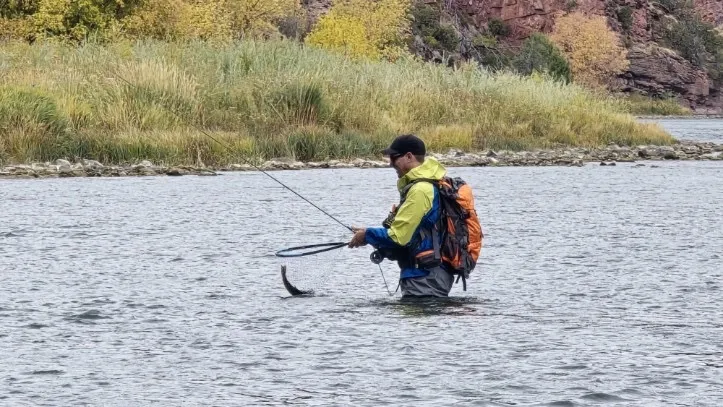
Written by Cameron Spanos
Eight thousand to fourteen thousand trout per mile. That's what Utah's Division of Wildlife Resources electrofishing surveys have pulled out of the upper Green River below Flaming Gorge Dam, and it's the number that ends every argument about why this tailwater is worth the drive. Most good Western trout streams hold 1,000 to 3,000 fish per mile. The Green River Utah sits in a category most rivers can't reach.
But density doesn't tell you which section to fish. And if you show up at Dutch John assuming all three sections of the Green River fish the same way, you'll waste a day.
Section A is a wading showcase wedged inside a red-rock canyon. Section B is a long float through scattered ranchland. Section C is desert, slow water, and a real shot at the biggest trout you'll catch all year. They're three different rivers stitched together by the same emerald-green tailwater.
The quick version: which Green River section is right for you?
If you're not sure where to start, here's the boiled-down call:
- First trip, no boat, want to see fish: Section A. Wade the trail. You'll see more trout in three hours than most rivers show you in a season.
- You have a drift boat or are hiring a guide and want fewer crowds: Section B. Bigger average fish, longer floats, far less pressure than Section A.
- You want shots at a 25- to 30-inch brown: Section C. Fewer fish, but the giants live here. Plan an overnight.
- Cicada season (late May through June): any section works, but B and C get the best dry-fly action because pressure on A spikes hard during the hatch.
Now the longer version, because the differences between these sections matter more than any quick chart can show.
Section A of the Green River Utah: 7.2 miles of wading paradise
Section A runs from the base of Flaming Gorge Dam to the Little Hole boat ramp. It's the most-fished, most-photographed, most-Instagrammed section of the Green River, and there are reasons for all of that.
The trail. A maintained path runs the entire 7.2 miles, with a raised boardwalk at the upper end. You can park at the dam and walk down. You can park at Little Hole and walk up. The named runs have names for a reason (the Lunch Counter, Secret Riffle, the Black Lagoon) and they hold fish on schedule. It's the rare river where a wade angler with no boat and no guide can have a stupidly good day.
Density on Section A is what makes the reputation. The upper reaches push past 10,000 trout per mile in good survey years according to Utah DWR data. Browns average 15 to 16 inches; rainbows run a little smaller. You will not be the only person standing in a riffle. On a sunny June Saturday, you might count thirty drift boats passing through a single run.
What Section A gets right
The clarity is unreal. You can sight-fish nymphs in 12 feet of water. The hatches stack: midges and Blue Wing Olives in March and April, caddis through May, then the famous cicada hatch in late May or early June when the ground temperature hits the mid-60s and the trout start eating fistfuls of black foam.
Wade access is genuinely unlimited. If you don't like the run you're standing in, walk 200 yards and find another. That's not how most blue-ribbon Western rivers work. Most of them, you're locked into whatever stretch you can reach from the gravel pull-off and a barbed-wire fence.
What Section A gets wrong
It's crowded, and the fish are educated. Yes, the trout are used to the boats and won't typically blow up at the sight of a raft. But spooked and selective are different problems. These trout see ten thousand size 22 zebra midges a year. You need 6X tippet, exact drift, and patience for refusal after refusal. A run that looks like it should produce on the first cast often takes thirty.
Hot take: Section A is the worst section to learn nymphing on, even though everyone tells beginners to start there. The fish density gives you false confidence. You'll get takes on bad drifts and assume you've got it dialed, then you'll move to a less-pressured river and stop catching anything. Better to learn somewhere the fish are dumber and the casts have to be cleaner.
Section B: the middle child everyone overlooks
Section B starts at Little Hole and runs nine miles to Indian Crossing in Browns Park. It's the section most anglers skip because it's harder to get to. You can't drive directly to either end without committing to a forty-five-minute to one-hour drive on rough roads through Browns Park.
That's the whole point.
You might also enjoy: Best All-Around Trout Fly Rod 2026: Sage R8 Core vs Orvis Helios vs Scott Centric vs Douglas Sky G
The B Section's upper half fishes like an extension of lower Section A: riffles, pools, big trout populations, similar techniques. The lower half changes character below where Red Creek dumps in. Sediment from Red Creek stains the water, the gradient flattens, and the river starts behaving like a slower, lower-density freestone. Average fish counts drop, but average fish size jumps. There are documented stories of fly anglers landing browns in the 25- to 30-inch range out of B.
Is Section B better than A for fly fishing?
If your definition of better is more fish per cast, no. If your definition of better is having a long pool to yourself for forty minutes, yes. The crowds drop off a cliff once you pass below Little Hole. Most A-section anglers never bother to drive the extra hour to put in below.
Section B is also where the cicada hatch produces the biggest dry-fly fish. The pressure on A pushes the largest trout onto the banks and into the slower water of B, where a black foam cicada drifted three feet from a willow can get eaten by something that looks like a small striper. That's not a guarantee. But it's a real possibility, which is more than most rivers in the Lower 48 can offer on a dry fly.
Float time on B runs about three to four hours of casual fishing. There are 17 designated campsites along the section, which means you can split it into two days if you want to actually fish each pool instead of skating through.
Wade access in Section B
Limited but real. The lower end flattens enough that you can anchor a boat and step out to wade riffles around the islands. There's some bank-walking near the campgrounds. But this isn't a wade-fish destination. You need a watercraft to fish B properly, whether that's a drift boat, a raft, or even a sturdy kayak.
Section C: where the giants actually live
Section C runs 11.5 miles from Indian Crossing through Browns Park National Wildlife Refuge to the Utah-Colorado state line. It's the longest section, the slowest, the warmest in summer, and the one where the legendary 30-inch browns actually get caught.
Five to seven hours on the water. Maybe more if you're stopping to fish properly. Most anglers split it into a two-day overnight trip because trying to cover 11.5 miles of slow water in a single day means hammering through pools that should be sat on for an hour each.
Trout density in C is the lowest of the three sections. Fewer fish, more spread out, in deeper holding water. But this is where streamer fishing earns its keep. A heavy sculpin pattern stripped along the cut banks of Browns Park is how most of the Section C giants get caught, not on a size 20 midge.
Why does Section C hold the biggest trout?
Two reasons. The slower water means lower energy expenditure for big fish, which means they can grow without burning the calories smaller fish burn fighting current all day. And the lower density means less competition for forage. A 28-inch brown in Section A is fighting 9,999 other trout for the same midge cluster. A 28-inch brown in Section C has a holding lie to itself.
This is also where the river starts feeling like the Western desert. Cliffs give way to rolling sage. The water is greener but warmer. By August it can push toward 65 degrees in stretches, which is the upper edge of where you should be ethically catch-and-releasing trout. Watch your thermometer.
What Section C gets wrong
It's a commitment. The drive in is long, the float is long, and if you blow up your raft on a rock you're a long way from a phone signal. You need to be self-sufficient. The wade access is poor (this section is functionally float-only) and on a slow day, it can feel like you're rowing through dead water for hours between bites.
How do Flaming Gorge dam releases change the fishing?
Flaming Gorge Dam controls the flow of all three sections, and the release schedule is more important to your trip than any fly choice. Per the Bureau of Reclamation's operating plan, releases are required to stay above 800 cubic feet per second at all times. Typical year-round flows sit between 800 and 1,200 CFS, with stable spring releases around 850 CFS before summer power generation kicks in.
Water temperature stays between 40 and 60 degrees Fahrenheit year-round because the dam pulls from the bottom of Flaming Gorge Reservoir. That's why the hatches are consistent and trout rise almost every month. It's also why Section A can be fishable in January when the rest of Utah's trout water is locked under shelf ice.
You might also enjoy: Best Fly Reels for Trout Under $300 (2026): 3 Picks I'd Actually Buy
Practical implications:
- At low flows (under 1,000 CFS), wade fishing in Section A opens up dramatically. Riffles you couldn't cross at higher flows become walk-throughs.
- At high flows (1,800 CFS or higher during runoff coordination releases), Section A becomes a float-only proposition and the fishing slides toward streamers and big nymphs.
- Sudden bumps in flow during summer power generation can shut off fishing for an hour while the fish reset. Wait it out instead of running back to the truck.
Always check the current release before you drive. The flow you fished last August is not the flow you'll see this June.
Picking your section by trip type
Here's the real-world breakdown most guides won't put in writing because they want to sell you the float package.
Solo wade trip, two or three days: Stay on Section A. Camp at Mustang Ridge or grab a room in Dutch John. Walk the trail. You don't need a boat to have a great trip.
Group of four with one drift boat: Float Section B. The boat angler covers water; the wade anglers in the group can hop out at the islands. You'll have less competition for runs than you'd have on A.
Hunting the trip-of-the-year fish: Section C, two-day overnight, streamer rods rigged with 1X tippet and articulated patterns. Don't go in May expecting cicadas. Go in late June through July when the foam bugs have pushed the giants into eating habits.
First-timer with kids: Section A, wade only, fish the slower pools below Little Hole boat ramp. You don't want to put a six-year-old in a drift boat for four hours.
Track which section produced what for you across multiple trips, and patterns will emerge. Water temp, flow, fly pattern, and time of day all interact differently on each section. Log your catches in Bushwhack and you'll start seeing your own version of the data instead of relying on the same generic guidance every other angler is reading.
What to bring regardless of section
The Green River Utah punishes anglers who show up under-equipped. The wading is real, the sun is intense, and the fish are picky enough that fly selection matters.
- A 9-foot 5-weight is the do-everything rod. Bring a 6-weight if you plan to throw streamers in C.
- Tippet down to 6X for technical Section A nymphing. Anything heavier and the rainbows refuse.
- Polarized sunglasses, copper or amber lens. The sight-fishing on this river is real and you can't do it in cheap shades.
- A net with a soft rubber bag. The fish are big enough that a small trout net is a liability.
- A water thermometer. Use it. Mid-summer Section C can creep past 65 degrees, and that's a fish-handling decision, not a suggestion.
The honest take
Section A gets the magazine covers because it's photogenic and accessible. Section B gets ignored because it's awkward to access. Section C gets mythologized because of the size of the fish that occasionally come out of it. All three are the same river, fed by the same dam, holding fish from the same gene pool.
If you only fish one section your first trip, do A. Walk the trail. See the canyon. Catch fish until your arm hurts.
If you've already done A and you're wondering if the Green River Utah is overrated because everyone you talked to fished the same seven miles of canyon as everyone else, go fish B and C. That's where the river opens up. That's where it stops being a destination and starts being a place.
Get fishing tips in your inbox
New guides, seasonal tactics, and gear picks — about once a month, no spam.