Early Morning Topwater Bass: The 90-Minute Window From First Light to Sun-Up
 Hudson Reed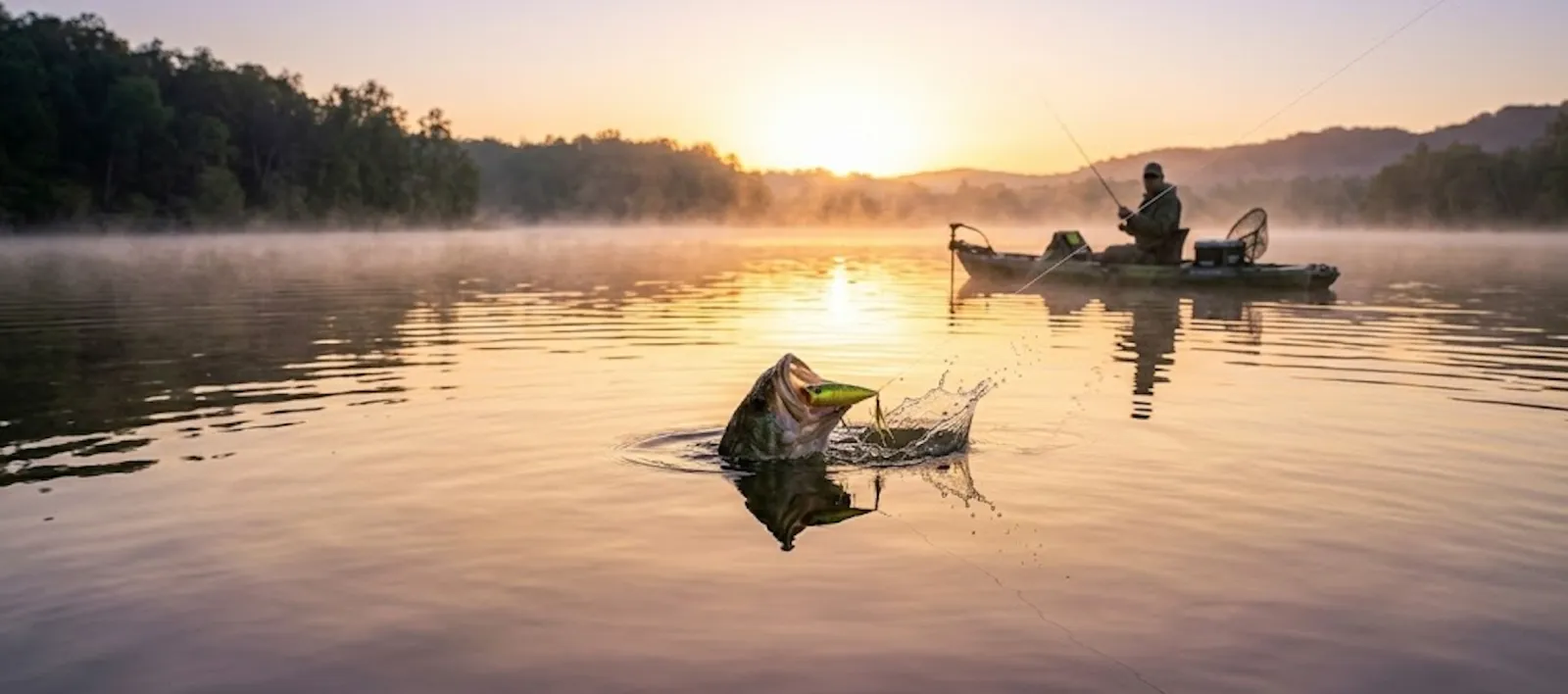
Written by Hudson Reed
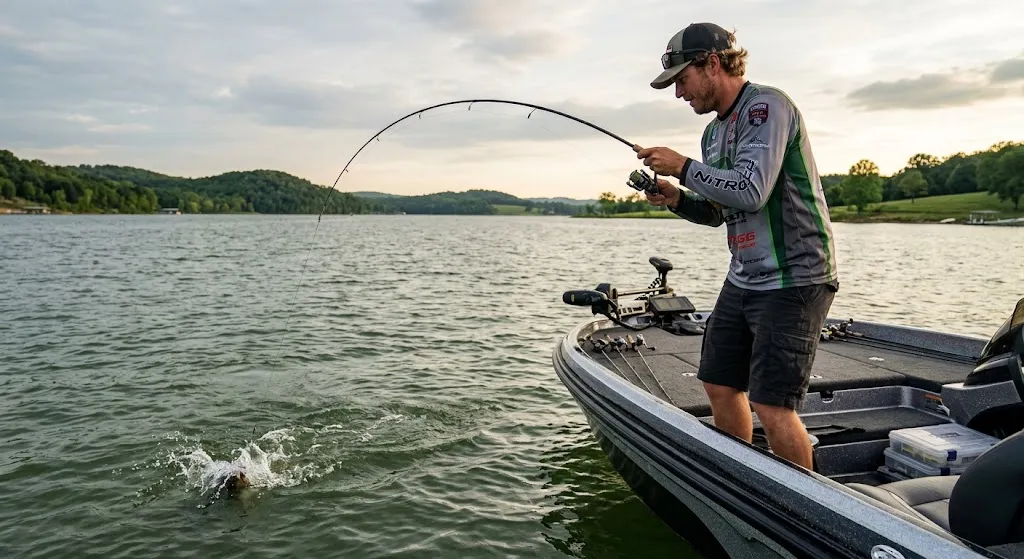
Three casts. That's how long my buzzbait lasted on the last Tuesday in May before a four-pounder ate it on the pause, somewhere in the gray light at 5:38 a.m. The sun wasn't up. The mist was still ankle-high on the water. I caught two more before 6:15, missed a giant on a popper at 6:40, and by 7:05 the surface had gone glass-flat and dead. Ninety minutes of early morning topwater bass. Done.
This is the most reliable pattern in bass fishing, and almost nobody fishes it correctly. Most anglers show up at 6:30 a.m. thinking they're early. They are not early. They have missed half the window.
The early morning topwater bite in late May and June is not a vague "go fishing at dawn" suggestion. It's a 90-minute event with a hard open and a harder close, and if you treat it like an all-day pattern you'll waste both ends of it.
Why the early morning topwater bass window exists
Largemouth and smallmouth bass are sight feeders, and in late May through June their eyes have a brief, perfect advantage. Surface light is low enough that bass below can see baitfish silhouettes against a brightening sky, while baitfish above can't see the bass coming up from below. Add water temperatures climbing through the 65 to 75°F sweet spot where bass metabolism peaks, and you get the most aggressive shallow feeding of the year.
Then the sun clears the trees. Surface glare wipes out the silhouette advantage, water heats past comfortable for any bass willing to stay shallow, and the fish either slide off the bank or stop hunting upward.
The Virginia Department of Wildlife Resources puts the best shallow-water topwater window at 5:30 to 7:30 a.m. in summer, with the bite typically ending at sunrise unless it's raining. That's not folklore. That's a state fisheries agency calling the same window every serious bass angler has felt on the water.
When does the topwater bite stop in summer?
The morning topwater bite ends when direct sunlight hits the water you're fishing. Not when the sun rises over the horizon. It ends when the light clears whatever's east of you (the treeline, the bank, the dock line) and puts hard glare on the surface.
On a typical late-May or June morning at 38 to 42° latitude, that's roughly 60 to 90 minutes after first light. First light is about 30 minutes before official sunrise, which means your window usually opens around 5:00 to 5:30 a.m. and the bite is gone by 7:00 to 7:30 a.m. Cloudy or drizzly mornings can stretch it past 9. A blue-sky morning with a low east bank can shut it down by 6:45.
The tell that it's over: bass stop committing. You'll get follows. You'll get a swirl behind the bait. You'll get a half-hearted bump. When a bass blows up on a buzzbait at 5:50 a.m. it tries to kill it. When the same bass refuses at 7:10, it's because the window is closed, and another 15 casts won't change that. Switch baits or change zones.
The four lures, in order
You don't need to bring four rods rigged with four different topwaters, but you should understand the order of confidence. The window is short enough that lure switching costs you fish.
Buzzbait: first 30 minutes
From first light until you can clearly read the water's edge, throw a buzzbait. Nothing else covers water that fast at the moment bass are most willing to chase. A 3/8 oz buzzbait with a clacker (Cavitron, War Eagle, or any double-blade) reeled just fast enough to keep the blade waking is the highest-confidence early-window bait of the year. White on dark mornings, black on bright ones, and a trailer hook on every single one because dawn bass miss buzzbaits constantly.
Cast parallel to cover, not at it. Most morning buzzbait fish eat ten feet off the bank, not against it.
Walking bait: first hour overlap
Once there's enough light to see your line on the water, switch to a walking bait. A Super Spook Jr., Sammy, or Yo-Zuri 3DB Pencil all work. This is the workhorse of the middle of the window. Walk it through points, isolated brush, and the outside edges of laydowns. Walking baits draw bass from farther than any other topwater because they keep moving and never give the fish a chance to study them.
You might also enjoy: Best Kids Fishing Rod and Reel Combo for 2026: Dock Demon vs Ugly Stik GX2 vs PLUSINNO
The bigger fish of the morning often eat a walker, not a buzzbait. Hold for a beat on the strike. Reel until you feel weight, then sweep. Setting on the splash misses fish.
Popper: the slow-water close
When the wind drops and the water goes oil-slick around the back of pockets and over isolated grass clumps, switch to a popper. A Rebel Pop-R 60 or 65 fished with a hard chug, a long pause, and one quiet twitch is what catches the last fish of the window. Use it on the spots a buzzbait wouldn't draw a look from anymore.
Frog: when the bite extends into mats
If you fish water with pad fields, matted grass, or laydown jungles (and especially if the sky is overcast), the frog is what keeps producing past 7:30. Mike Bednarski, Chief of Fisheries at Virginia DWR, has noted that frogs and toads work surprisingly well even when there's boat traffic or wind, because the surface chop hides the lure. He uses 50 lb braid and a 7-to-8-foot heavy action rod for it. That's not overkill. That's what you need when a five-pounder eats a frog in a mat.
Hot take: most anglers throw the frog too early. Frogs are a closer, not an opener. Burn the buzzbait first while bass are willing to chase open water, then go to the frog when the bite contracts back into the heaviest cover.
Where to position the boat before sunrise
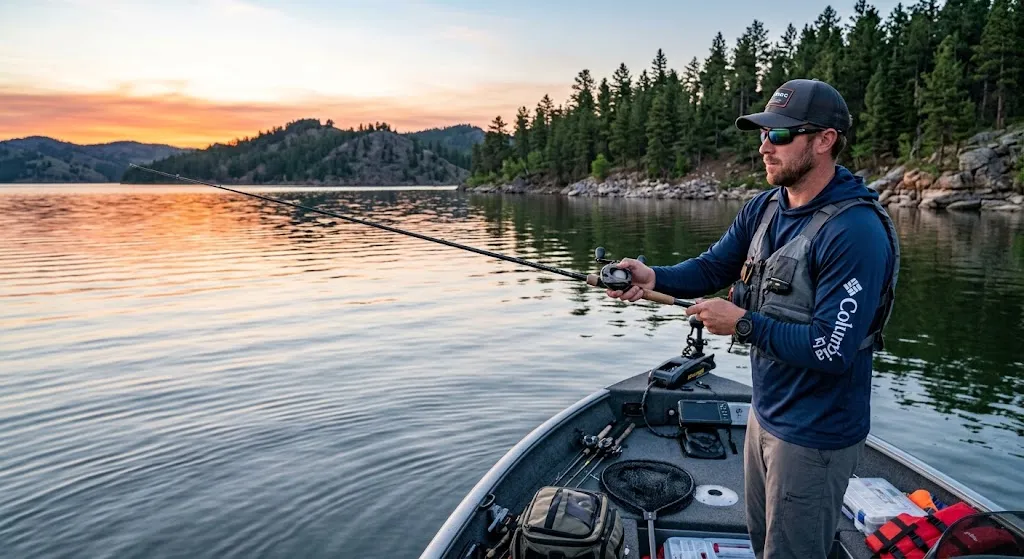
If you're motoring around at first light deciding where to fish, you've already lost ten minutes of the best ten minutes of the day. Position the night before, mentally. Pick three spots in order, and have the boat on the first one with the trolling motor down before the eastern sky goes from black to gray.
The order that works in late May and June on most lakes:
- First spot (5:00 to 5:30 a.m., full dark to first gray light): A flat, isolated cover-heavy zone with bait. Back of a creek arm, a long secondary point with brush, a shallow grass flat with bluegill activity the evening before. The biggest fish of the morning typically eats here in near-darkness on a buzzbait.
- Second spot (5:30 to 6:30 a.m., gray light into first sun): A transition. A point that drops from 4 feet to 12, a laydown on a 45-degree bank, a riprap line near the channel. Walking bait water.
- Third spot (6:30 to 7:30 a.m., full sun creeping in): The shadiest cover you can reach. The west bank of the lake if the east bank is open. Docks on the shaded side. Mat edges. Slow popper and frog water.
Run the lake from east to west as the morning progresses. You want the sun behind you and shade in front of you for as long as you can manage it. Fish the shadow line, not the lit water.
The water temperature trigger
The pattern lights up when surface temps hit the mid-60s and stays hot through the mid-70s. Below 65°F bass will eat a topwater but they won't commit at first light. They want full daylight and a warmed shallow zone. Above about 78°F at dawn, the morning shallow population has thinned out, the offshore pattern is taking over, and the 90-minute window starts to contract toward the actual sunrise minute.
Carry a thermometer. A $9 probe is the cheapest edge in bass fishing.
The most predictable dates: in the mid-Atlantic and Southeast, last week of April through mid-June. In the upper Midwest and Northeast, last week of May through the first week of July. The window doesn't disappear in July and August, but it shortens to 45 minutes and the bigger fish stop showing for it as consistently. Late May and June is the peak. That's the time to be on the water at 4:45 a.m.
What anglers get wrong
The two most common mistakes I see, in order of how much they cost you:
One. Showing up at 6:30. Sunrise is not the start of the window. First light is. By the time you launch the boat, idle to your spot, and tie on a lure at 6:45, the prime 45 minutes are gone. The fish that ate at 5:35 are off the bank.
You might also enjoy: Pike Fishing for Beginners: The Freshwater Predator Most Anglers Overlook
Two. Fishing too slowly. Anglers see "topwater" and think delicate presentation. In the gray-light window, bass eat fast-moving baits because they're locked into chase mode. Save the long pauses and subtle twitches for after the sun is up and the bite contracts. From 5:30 to 6:15, reel.
A smaller third one: not logging it. You will not remember six weeks from now whether last Tuesday was the day you got six fish before 6 a.m. or the day you only got two. The pattern repeats itself across years, on the same spots, within a few degrees of the same water temp. Log your catches by time of day and water temp and you'll have a real morning playbook by the time June rolls around again. Far more useful than anything you can read.
Is the morning topwater bite better than the evening?
In late May and June, yes, and it's not particularly close. Evening topwater can be excellent (it's why MidWest Outdoors and other publications talk about the "20-minute window" at sunset) but the morning window is longer, around 90 minutes versus roughly 20 to 30, bigger fish eat in it, and you don't have to deal with afternoon boat traffic, recreational pressure, and a lake that's been beaten on for ten hours.
The trade-off is that you have to set an alarm for 4:15 a.m. Most anglers won't. That's part of why the bite is so good.
How to know the window is closing in real time
Three signs, in this order:
Surface composition changes. The water goes from a soft, slate-gray sheen to a bright, glaring blue-silver as direct sun hits it. That visual shift is your two-minute warning.
Strikes become commitless. Boils that don't connect. Pushes behind the bait. Fish that follow the buzzbait to the boat and turn off. You're now fishing on borrowed time.
Baitfish disappear from the surface. Look at the shallow flats. When bluegill stop dimpling and the shad balls slide off into 8 to 10 feet, the bass have already followed.
When you see two of those three signs, switch off topwater. The next pattern of the day is a wacky rig or a shaky head along the same banks you just fished, or a Texas-rig moving out to the first break. Don't burn a half hour proving to yourself the topwater is dead. It's dead, and the fish have moved 15 feet deeper.
The 4:15 a.m. checklist
You don't need much, but what you bring matters. The five things to have ready the night before so you can be casting at first light:
- Three rods rigged: buzzbait, walking bait, popper. Tied. Hooks sharp. Tested in the driveway.
- A 7-to-8-foot heavy frog rod with 50 lb braid in the rod locker for the back end of the window.
- A water thermometer.
- A headlamp on red mode (white light blows out your night vision and bass-spook the shallows).
- The first spot picked. Not "somewhere on the lake." The exact spot, in your head, before you go to sleep.
Show up dialed in. Fish hard for 90 minutes. Then take a break, drink your coffee, and figure out what comes next. The window doesn't reward grinding. It rewards being ready when it opens.
Late May and June, set the alarm. The 5:30 a.m. buzzbait fish doesn't care if you're tired.
Get fishing tips in your inbox
New guides, seasonal tactics, and gear picks — about once a month, no spam.