Best Neoprene Wading Socks for Cold Water: 2 Picks Worth Buying This Fall
 Cameron Spanos
Written by Cameron Spanos
A neoprene sock is the highest-return $20 in a wading kit, and most anglers buy one in June, when they need it least. The stretch where neoprene wading socks for cold water actually change your season starts about now: late August into early October, when river temps slide out of the mid-60s and bare feet in mesh shoes start filing complaints by hour two.
Same shoes. Same laces. One layer of foam between your skin and 58-degree water, and you get roughly six more weeks on the river before the waders come out of the garage. Two socks clear my verification bar this month, which is fewer than I expected and worth explaining, so that's a section below too. Along with what the millimeter number really buys you and the water temperature where a sock stops being the answer.
Quick Picks
| Sock | Best For | Thickness | Price | Amazon Rating | Reviews |
|---|---|---|---|---|---|
| Korkers I-Drain Neoprene Wading Sock 2.5mm | Best overall, and best in snug shoes | 2.5mm | $34.99 | 4.7 / 5 | 142 |
| Riverruns Neoprene Wading Socks | Cheapest honest way to try wet wading in fall | 3-layer, unspecified | $19.99 | 4.1 / 5 | 261 |
Korkers I-Drain Neoprene Wading Sock 2.5mm: Best Overall

4.7 stars across 142 ratings is the best score I could verify in this category, and the spec I'd point at first is the thickness. At 2.5mm the I-Drain goes into a low-cut wet wading shoe sized for a bare foot without eating the volume a thicker sock would. The perforated footbed is the whole premise of the I-Drain line: Korkers builds it to push water out rather than hold it against your skin.
This is the plain wading sock, not the Guard Sock, so there's no gravel guard on it. Korkers sells the 3.5mm I-Drain Guard Sock with an integrated gravel guard at $44.99 on its own site as of this writing, and that's the one to chase if you fish gravel. The 2.5mm is for sand, mud, ledge rock, and tailwaters where grit isn't the enemy.
One caveat straight from Korkers: its own listing pitches this sock for flats and warm water. Take that at face value. This is shoulder-season gear, not November gear.
Who it's for
Anglers whose wet wading shoes fit close, fishing sand, mud, or ledge-rock bottoms with water still in the 60s.
Pros and cons
- Highest-rated wading sock I could verify, at 4.7 stars
- 2.5mm, the thinner of the two picks, so it costs almost no room in the shoe
- Perforated footbed is the I-Drain line's drainage feature
- No gravel guard on this version
- Korkers itself pitches it for flats and warm water
Price: $34.99. Check the Korkers I-Drain on Amazon.
Riverruns Neoprene Wading Socks: Best Under $20
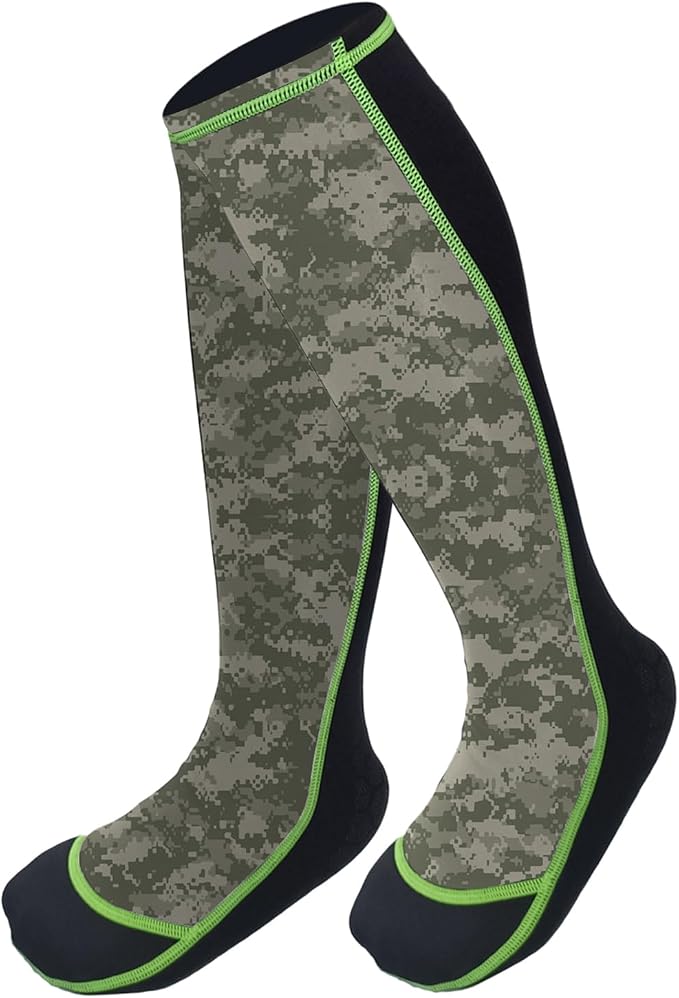
Twenty bucks, 261 Amazon ratings, a 4.1-star average. That's a lot of social proof for the cheapest thing in the category. The Riverruns is a tall, knee-high sock with flatlock seams and a silicone print on the sole, which is aimed at the thing cheap neoprene socks are worst at: creeping and rolling around inside a boot.
Two honest knocks. The listing never states a thickness, only "three layer neoprene," and a spec a manufacturer won't print is usually a spec you wouldn't like. No gravel guard either, so grit finds its way in over a long day. The knee-high cuff helps a little, but a cuff is not a guard.
Who it's for
Anglers who already own wet wading shoes and want proof an extra layer changes anything. It does. This is the cheap way to find out.
You might also enjoy: Best Inline Spinners for Fall Stocked Trout Under $20 (2026): Buy or Skip on 4 Classics
Pros and cons
- Cheapest verified option that isn't a repurposed dive sock
- Silicone-printed sole, which most socks at this price skip
- Flatlock seams, so less bulk where the shoe presses on your instep
- No published thickness
- No gravel guard
Price: $19.99. Check the Riverruns on Amazon.
Why only two picks?
Because most of what Amazon lists under this search doesn't survive a basic check. Four things have to be true before a product gets named here: a rating of 4.0 or better, at least 100 real reviews behind that rating, a live in-stock button, and a listing that isn't a relic. Run that filter across the first page of results and the field collapses fast.
Two near-misses are worth knowing about, because both are probably good socks. The 8 Fans 3mm sock has the best feature list in the whole category, a fold-down gravel guard with a boot hook plus a perforated footbed, at $30.19 and a 4.3-star average. It has 40 reviews. The Simms Neoprene Wading Socks are the genuine article at 2.5mm and $45, rated 4.6, sitting at 76 reviews.
Neither clears 100. That isn't a knock on the socks, it's a knock on the sample size, and the difference matters more than it sounds: 100-plus reviews is roughly where sizing problems stop hiding. Both are worth a second look next spring once the numbers fill in.
2.5mm vs 3mm: does the extra half-millimeter matter?
Less than the internet thinks. Every fishing-branded sock I could verify runs 2.5mm or thicker, up to 3.5mm, and I'd treat the gap between 2.5 and 3 as close to negligible for a day's fishing. If you're deciding between those two, decide on fit instead.
That's the tradeoff nobody prints on the packaging. Size your wet wading shoes to a bare foot, as most people are told to, and a thicker sock adds enough bulk to cramp your toes and squeeze circulation, which can leave your feet colder than the thinner sock would have. Cold feet while wet wading are usually a fit problem wearing a thickness costume.
My rule: 2.5mm if the shoe was sized bare-foot, 3mm if you sized up half a size or you're in standard wading boots with room for a wader bootie. I'd skip 3.5mm unless you fish cold water often enough that the bulk is worth it.
What a gravel guard actually does
A gravel guard is a neoprene cuff extending a couple of inches above the boot collar, folded down over your laces and hooked to them. That's it. Not warmth, not waterproofing. It exists so pea gravel and sand stop funneling into your shoe every time you step in moving water.
The annoying part: neither pick above has one. The Korkers is the plain wading sock and the Riverruns is a tall wetsuit-style sock with a cuff, not a guard. So here's my actual advice if you fish gravel bottoms, and it runs against how this site usually makes money: buy your guard sock direct from the manufacturer. As of this writing, Korkers lists the 3.5mm I-Drain Guard Sock at $44.99. Simms lists the Guide Guard Socks at $65, which is a separate model from its $45 plain neoprene sock, with 3.5mm neoprene, a boot hook, and a perforated footbed for drainage. Both are easier to buy in the right size on the brand's own site, where the sizing chart actually lives.
Skip aftermarket strap-on gravel gaiters entirely, whatever you do. They loosen over a few hours of walking, roll down the boot, then catch your fly line at exactly the moment a fish is eating. A guard sewn onto the sock grips your calf instead of your laces, so it stays put through a full day of bank scrambling. That single design difference is why the fly-shop socks cost what they cost.
The naming is the trap, so read the model name. "Guard Sock" has one. "Wading Sock" usually doesn't.
How cold is too cold to wet wade?
My cutoff is 58 degrees. Below that, waders, regardless of how nice the air feels. Above it, a 3mm sock gets me a full day in low-60s water and short sessions in the upper 50s, but that's my tolerance rather than a spec, and yours could sit five degrees either side of it.
You might also enjoy: Tenkara Fishing Utah's Uinta Mountains: Brook Trout Water Built for a Fixed Line
The old forum arithmetic still works: add air temperature to water temperature, and if the sum clears 100, wet wading is fine. Crude, but on a 78-degree afternoon over 62-degree water it lands on the right answer.
The part that isn't about comfort: the National Weather Service notes that cold shock from water at 50 to 60 degrees can be just as severe as cold shock at 35 degrees. That's the number that should set your cutoff, not your tolerance for discomfort. Slip and go in to your chest in 54-degree water on a 45-degree October morning, and the involuntary gasp is a drowning risk before hypothermia is even a factor. Waders and a cinched wading belt change that math entirely.
Depth matters more than temperature anyway. Ankle-deep in 55-degree water is a non-event; thigh-deep in 62 runs you off the river in an hour. Log water temps next to how long you lasted and you'll find your own cutoff inside a season. Try Bushwhack if you want those numbers somewhere better than memory.
How to pick neoprene wading socks for cold water
Four things decide whether a sock is worth owning, in this order.
Fit first. Size toward snug, because neoprene relaxes. A sock that slides inside your shoe will rub a blister inside a day of walking, and no thickness rating fixes that.
Gravel guard second. Integrated, hooked to the laces, sitting above the boot collar. On gravel bottoms this outranks warmth.
Drainage third. Perforated footbeds are not marketing. A sock with a solid footbed holds water against your skin instead of letting it out, which is the opposite of what you want on a cold morning.
Thickness last. 2.5mm or 3mm covers most fall wet wading in the lower 48. Spend the difference on a second pair.
Our pick
Buy the Korkers I-Drain Neoprene Wading Sock 2.5mm at $34.99. It's the best-rated sock I can actually stand behind, and the 2.5mm profile suits the low-cut wet wading shoes most people are pairing it with. Order snug.
If you just want to test whether an extra layer buys you the fall, the Riverruns at $19.99 answers that this weekend for the price of two coffees and a tip. And if your home water is gravel, spend the $44.99 with Korkers direct for the 3.5mm Guard Sock version instead of either of these.
Order in the next couple of weeks rather than in October, when the water has already dropped and a sock in the mail does you no good. Track the first few cold trips and by next fall you'll know your own cutoff instead of guessing at mine. Bushwhack is one place to keep that.
Get fishing tips in your inbox
New guides, seasonal tactics, and gear picks — about once a month, no spam.